Skim the text first
Skim the transcript in the few seconds before the recording starts. Get a general idea of the topic — this helps you focus on the words you might hear.

Fill in the Blanks (Type In) tests your ability to listen carefully to a short audio recording and type the missing words into a transcript shown on screen. Each correctly spelled word scores 1 point — there is NO negative marking, so always fill every blank. On this page: an overview, the exam interface, top strategies (Before / During the test), common mistakes, points to remember and a full simulator with two practice items.
Length of recording:
30–60 seconds
Number of missing words:
4–6 blanks
Type of recording:
audio only (not video)
Number of these tasks in each test:
2–3
Total time for all listening tasks:
31–39 minutes
Fill in the Blanks (Type In) tests your ability to type the missing words in a transcript while listening to a short academic recording. After a 7-second countdown the audio plays once — you cannot pause or replay it. Type each missing word into the blank as you listen, or take notes on your erasable booklet and fill the blanks after.
Task
Listening — Fill in the Blanks (Type In)
Listening
Overall
Your voice → analysed by AI → contributes 8% to Listening and 3% to Overall.
Official PTE School walkthrough — how to answer Listening Fill in the Blanks (Type In).
The screen below is annotated with green markers (1–5). Press Start: a 7-second countdown plays, then the audio begins automatically. You CANNOT pause or replay the recording — only volume can be adjusted. Click any blank and type the missing word. The 'Next' button only becomes active after the audio ends.
Annotated walkthrough of the actual Pearson screen. 7-second countdown → audio plays once (no pause / no replay) → fill the blanks → press Next.
You will hear a recording. Type the missing words in each blank.2Read the prompt. You'll see a transcript with blanks — type the word you hear in each blank.
Press Start to begin
Hover the green markers to see what each part of the screen does.
Skill assessed
Listening
Score weight
up to8points
The AI scorer checks
Criterion
Identifying words and phrases appropriate to the context.
Pronunciation
Recognising the pronunciation of academic vocabulary.
Criterion
Using context to help identify words you only partially heard.
Criterion
Spelling the words you typed correctly (British or American).
Criterion
Identifying the main ideas and supporting points.
Criterion
Identifying details, opinions, definitions or sequences.
Purpose
Making inferences from the information heard.
Comprehension
Inferring the meaning of unfamiliar words.
Purpose
Listening for organisation and connections between information.
Build the five habits below into your daily practice so they feel automatic on test day.
Five habits to build before test day so they feel automatic in the exam.
Skim the transcript in the few seconds before the recording starts. Get a general idea of the topic — this helps you focus on the words you might hear.
You might find it easier to type as you listen, but taking notes and completing the blanks at the end is also a good strategy. Use abbreviations (e.g. write disc if you hear discount).
Spelling words correctly could be the difference between getting an answer right or wrong in this task. Each correctly spelled word = 1 point.
Practise reading at the same time as listening. You need to follow the script on screen so you don't get lost or miss any blanks.
Quickly review your work before pressing Next. Use grammar clues to check the correct form of the word (verb tense, noun, adverb, adjective, etc.).
Use online listening gap-fill activities to practise choosing grammatically correct words for blanks in texts.
Find some academic podcasts or lectures online and practise like this:
Practise both strategies: taking notes while listening AND typing into blanks as you listen. Decide which you're better at, then use your preferred approach in the test. You will need to type quickly, so practise this in English as much as you can.
You should check your spelling after listening.
You shouldn't worry about spelling while listening — focus on hearing the word first.
You should listen very carefully and use only what you hear.
You shouldn't type a word based just on your own knowledge or what you think makes sense — everything you need is in the audio.
You should add something to every blank.
You shouldn't leave any blanks empty — guessing is better than leaving a blank, because there is NO negative marking.
You should keep an eye on the listening-section timer.
You shouldn't spend too much time on one task — listening items are not timed individually.
You should check that your answers are grammatically correct.
You shouldn't forget to check that every word makes sense in the sentence.
Practise here without strict markers. Press Start: 7-second countdown → audio plays once (no pause / no replay) → type the missing word in each blank. Press Show Answers to see the correct words and check your spelling.
Same Pearson-style screen as the real test. Listen, take notes, fill every blank.
You will hear a recording. Type the missing words in each blank.
Press Start to begin
Private to you — tick each item you actually did. Saved on this device only.
Send a screenshot of your filled blanks on WhatsApp and our trainers will check your spelling and word choice — and explain why each correct answer fits.
💬 Get evaluated on WhatsApp
Watch the most frequent mistakes test takers make in FIB-L — and how to avoid each one.
Read at the same speed as the speaker is talking
During Fill in the Blanks (Type In) and Highlight Incorrect Words, you need to read a transcript while listening to the recording. Read the text at the same speed as the speaker is talking. If you get behind, it can make it difficult to complete these tasks successfully.
Manage your time across the whole listening section
Listening items (apart from Summarize Spoken Text) are not timed individually. You will have between 31 to 39 minutes for all the listening items. Make sure you practise managing your time effectively across all the tasks.
In the seven seconds before the recording begins, you only have time to skim the text. As you do this, ignore the gaps and try to get an overall idea of what the text is about. This will help you recognize the words that fit the gaps, as you hear them.
Some of the things you can look for:
• Proper nouns (that begin with a capital letter). They can give you information about people and what they do (e.g. 'Mike Griffiths … conservationist'), places (e.g. 'Indonesian island of Sumatra') and organizations (e.g. 'conservation group The Leuser International Foundation'). Don't worry if you don't know where or who they are.
• Nouns that are repeated in the text. They may help you decide on the topic.
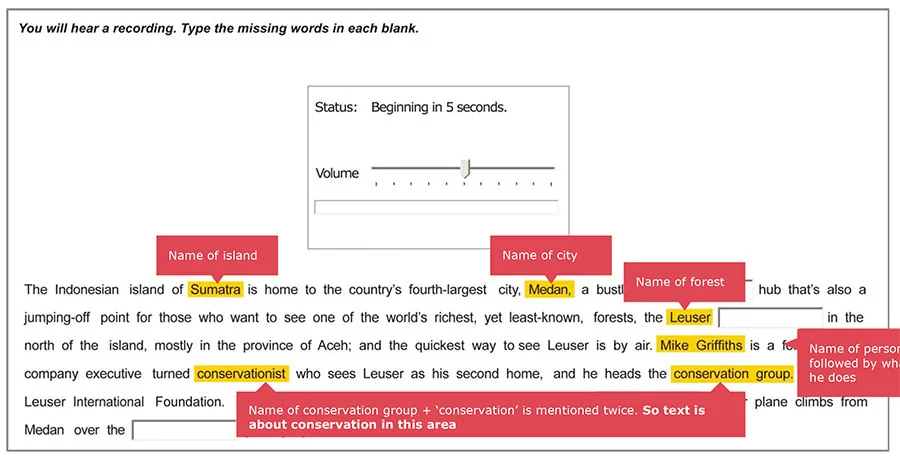
The recording is at normal speed and is only played once. When you are listening, you do not have time to think about how to spell the missing words. Use your erasable note-board booklet to write down what you think you hear.
After the recording has finished, you can read through the text, and use your notes to decide on the words that are missing and how they are spelled. Then type them into the gaps.
Remember, the next item does not start until you click Next (N) at the bottom of the screen, so you have a little time to think about your answers.
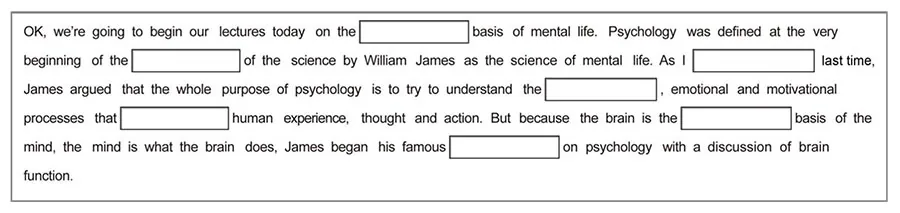
Your response is judged on your ability to listen for missing words and type them into the transcription. Each correct word with correct spelling scores 1 point. If all blanks are filled correctly, you get the maximum score. If some are wrong, partial credit applies. There is NO negative marking — always fill every blank, even if you have to guess. This task contributes to your Listening score (and indirectly to Writing via spelling).
Listening Fill in the Blanks and Write from Dictation give you a point for each word typed and spelled correctly. WFD is the highest-yield Listening task because every word you nail counts.
Coach tip · Every word counts — never leave a blank empty. There's no negative marking, so a grammatical guess is always better than nothing.