
PTE Academic Skill Profile

    Your four scores tell you how much you missed.
    Your Skill Profile tells you exactly why.

    The Skill Profile is the most specific, most actionable thing Pearson gives you — and most candidates never read it. This is the complete breakdown: all 8 categories, every task weighting, the August 2025 changes, a real case study, and a 4-week plan to fix exactly what's holding your score back.

    Sample Skill Profile

    Short SpeakingBelow Expectation
    Reproducing Spoken & Written LanguageBelow Average
    Extended SpeakingBelow Average
    Short WritingBelow Average
    Open Response Speaking & WritingAverage
    Multiple-skills ComprehensionAverage

    Shortest bars = highest priority. They point to the exact tasks to drill before your next exam.

    10 yrs
    Teaching PTE since 2015
    5,000+
    Students coached
    49
    Countries reached
    600+
    Perfect 90 scores
    The most expensive mistake

    Why most candidates read their results completely wrong

    A student opens their results, looks at the four numbers, feels disappointed — and then prepares the same way as before. They never read the Skill Profile. That's not expensive in money. It's expensive in time, visa deadlines, registrations and enrolments.

    A Speaking score of 36 doesn't tell you whether the problem is fluency on long responses, accuracy on short responses, connected-speech reproduction, or content under time pressure. Your Skill Profile does. Once you know which specific bars are low, you know — with precision — which of the 22 task types to drill, and in which order.

    This page gives you the complete picture: every Skill Profile category, every question type, every common mistake, and every fix.

    What changed — 7 August 2025

    The PTE update that changes how you should prepare today

    Four shifts that directly affect your Skill Profile. Ignore them and you'll prepare for an exam that no longer exists.
    1

    Two new scored tasks

    Summarize Group Discussion (20% Listening, 19% Speaking) and Respond to a Situation (13% Speaking) became fully scored on 7 August 2025 after 15 months as trial items.

    2

    Content is now king

    Since 2023, Pearson's AI weights content recognition far more heavily. Memorised templates and generic phrases that used to pass are now detected and scored lower.

    3

    Human review is built in

    For Describe Image, Retell Lecture, SGD, RTS, SWT, Essay and SST, ambiguous or off-topic responses are now routed to a human. You cannot game these with templates.

    4

    Portal scores can't be trusted

    Third-party practice portals are not aligned to Pearson — often not even 10%. Get a manual qualitative assessment of speaking and writing before your next exam.

    The framework

    The 8 Skill Profile categories — fully decoded

    Tap any category to see what it measures, which tasks drive it, why candidates score poorly, and exactly how to fix it.
    Describe ImageSpeaking 31%Retell LectureListening 13%, Speaking 13%Summarize Group DiscussionListening 20%, Speaking 19%Respond to a SituationSpeaking 13%Summarize Written TextReading 23%, Writing 28%Write EssayWriting 31%Summarize Spoken TextListening 10%, Writing 18%

    Why scores drop

    Describe Image with no formula runs out of content before 40s (a fluency failure). Essays that describe instead of committing to a thesis. SGD treated like Retell Lecture. SST compressed from two directions by weak listening and weak writing.

    How to fix it

    Describe Image: four-part formula every time (Open → Main Point → Comparison → Conclude), 4 anchor words in the 25s prep, 70–80 words. Essay: thesis in line one, PEEL each paragraph, 220–260 words. SGD: track themes not speakers. SST: use the full 10 minutes, content first then grammar, 50–70 words.

    Where your points come from

    How each of your four skill scores is actually built

    The weightings are drastically unequal. Spending equal time on every task is not a strategy — it's a way to waste preparation time.

    Speaking score

    Describe Image31%
    Summarize Group Discussion19%
    Repeat Sentence16%
    Retell Lecture13%
    Respond to a Situation13%
    Read Aloud9%

    Three tasks — Describe Image, SGD, Repeat Sentence — are 66% of your Speaking score.

    Listening score

    Summarize Group Discussion20%
    Repeat Sentence17%
    Retell Lecture13%
    Write from Dictation13%
    Summarize Spoken Text10%
    Fill in the Blanks (Type In)8%
    Highlight Incorrect Words8%
    Answer Short Question4%
    MCMA (L)3%
    Highlight Correct Summary2%
    MCSA (L)2%
    Select Missing Word1%

    Summarize Group Discussion is the single highest-weight Listening task — and the most under-practised.

    Reading score

    Fill in the Blanks (Dropdown)25%
    Summarize Written Text23%
    Fill in the Blanks (Drag & Drop)20%
    Highlight Incorrect Words13%
    Reorder Paragraph9%
    MCMA (R)5%
    Highlight Correct Summary3%
    MCSA (R)3%

    Summarize Written Text sits in the Speaking & Writing section yet contributes 23% of your Reading score.

    Writing score

    Write Essay31%
    Summarize Written Text28%
    Write from Dictation23%
    Summarize Spoken Text18%

    Write from Dictation contributes 23% of Writing — yet it is a Listening-section task.

    The highest-leverage insight

    The cross-skill effect — 5 tasks that move everything

    These five tasks each feed two score columns and three Skill Profile bars at once. One weakness suppresses your results from multiple directions.
    Repeat Sentence
    Listening 17%, Speaking 16%
    Short Speaking · Reproducing · Multiple-skills
    Write from Dictation
    Listening 13%, Writing 23%
    Short Writing · Reproducing · Multiple-skills
    Summarize Group Discussion
    Listening 20%, Speaking 19%
    Open Response · Extended Speaking · Multiple-skills
    Retell Lecture
    Listening 13%, Speaking 13%
    Open Response · Extended Speaking · Multiple-skills
    Summarize Spoken Text
    Listening 10%, Writing 18%
    Open Response · Extended Writing · Multiple-skills

    One hour on Repeat Sentence moves two score columns and three Skill Profile bars. One hour on Multiple Choice Single Answer moves one column and one bar. Always address cross-skill tasks first.
    A real student, a real result

    78 on a practice portal. 36 in the real exam.

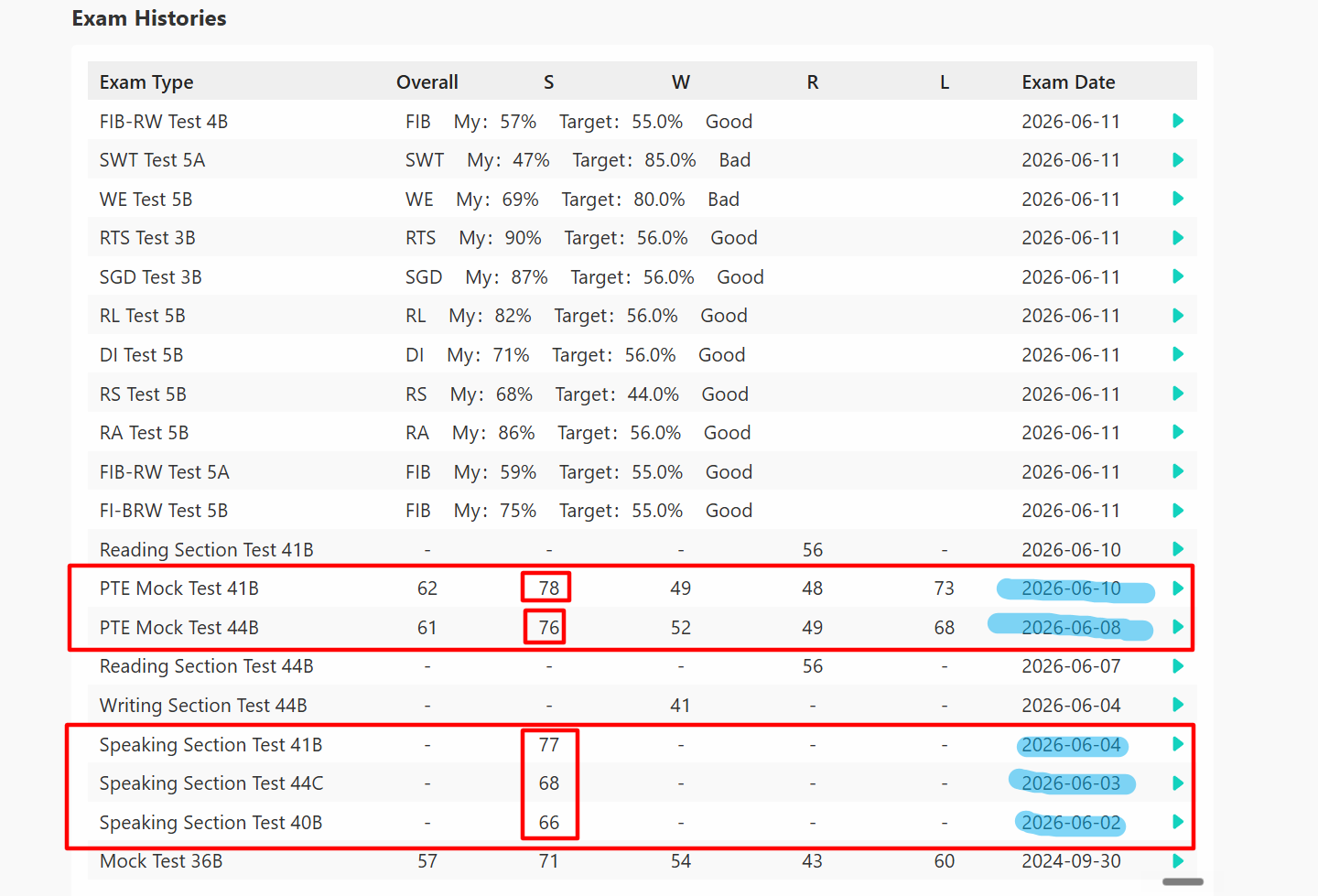
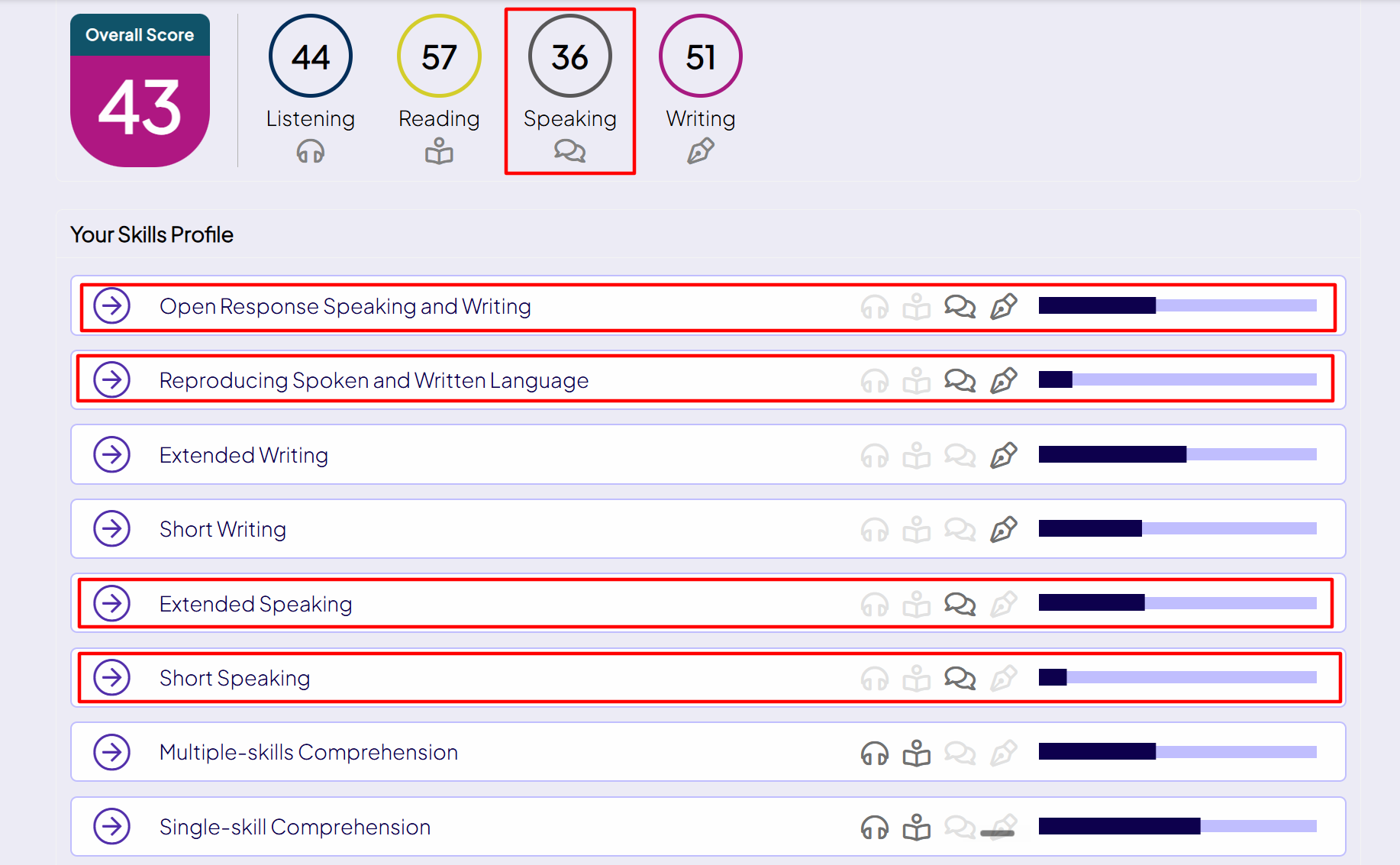
    Preparing for nursing registration in Australia (Speaking 76 required), she scored 78 and 76 in Speaking on a portal days before — then received 36. Here's what the Skill Profile revealed.
    Her story in her own words — what went wrong and how she's fixing it.
    BEFORE · Practice portal
    Practice portal exam history showing Speaking scores of 78, 76, 77, 68 and 66
    Portal history — Speaking 78 and 76 on full mocks just days before the real exam.
    AFTER · Real PTE exam
    Real PTE Academic Skill Profile: Overall 43, Speaking 36
    The official result that counts — Overall 43, Speaking 36 against a target of 76.

    Portal scoring is not Pearson scoring. Those encouraging numbers gave a false sense of readiness — a 40-point gap from her best portal score to the real exam.

    Overall
    43
    target 79
    Listening
    44
    target 58+
    Reading
    57
    target 59+
    Speaking
    36
    target 76
    Writing
    51
    target 65+

    Her Skill Profile bands — shortest = highest priority

    Short SpeakingBelow Expectation
    Reproducing Spoken & Written LanguageBelow Average
    Extended SpeakingBelow Average
    Short WritingBelow Average
    Open Response Speaking & WritingAverage
    Multiple-skills ComprehensionAverage
    Extended WritingAverage
    Single-skill ComprehensionAverage–Above

    Short Speaking (Read Aloud + Repeat Sentence), Reproducing (adds Write from Dictation) and Short Writing (Write from Dictation only) are all below average. From the Skill Profile alone — before seeing any individual question score — we can identify with high confidence that Repeat Sentence and Write from Dictation are her two most underperforming tasks.

    Do this after every test

    How to read your own Skill Profile in 4 steps

    Every time you finish a PTE test — official or practice — read the Skill Profile first. Before the four scores. Before the overall.
    1

    Identify your two shortest bars

    Two categories is the practical working limit for four weeks of focused preparation. Don't try to fix all eight at once.

    2

    Map each bar to its question types

    Short Writing low → Write from Dictation only. Extended Speaking low → Describe Image, Retell Lecture, SGD, Respond to a Situation.

    3

    Find the overlap between your two low bars

    Any task on both lists is your absolute first priority — one improvement moves both bars. If no overlap, fix the higher-percentage task first.

    4

    Track each bar after every mock

    Moved up → the drill works. Didn't move → adjust or give it more time. Dropped → a new problem; investigate before the next cycle.

    Your study order

    Drill in this exact order for maximum return

    Each Tier 1 task affects two score columns and three Skill Profile bars — the highest return per hour. Work top to bottom.

    Tier 1 — Cross-skill multipliers (first)

    Repeat Sentence · Write from Dictation · Summarize Group Discussion · Retell Lecture · Summarize Spoken Text

    Tier 2 — High-weight single-skill tasks

    Describe Image (S 31%) · Fill in the Blanks Dropdown (R 25%) · Write Essay (W 31%)

    Tier 3 — Medium-weight tasks

    Summarize Written Text · FIB Drag & Drop · Respond to a Situation · Read Aloud · Reorder Paragraph · Highlight Incorrect Words

    Tier 4 — Low-weight tasks (maintain)

    All MCQ variants · Highlight Correct Summary · Select Missing Word · Answer Short Question · FIB Type In

    Before you sit again

    Four things to do before your next PTE exam

    The exam costs $490. One more week of targeted preparation isn't a delay — it's an investment.
    1

    Take a full-length test and read the Skill Profile

    Identify your two lowest bars, map them to question types, and build a targeted drill schedule.

    2

    Get a manual assessment of speaking & writing

    Have someone who understands what the AI evaluates review your spoken and written responses.

    3

    Drill the specific tasks your profile identifies

    Not general practice. Task-specific practice produces task-specific improvement.

    4

    Run a final timed mock and confirm the bars moved

    If a bar didn't move, drill one more week. If a new bar dropped, fix it before sitting.

    Common questions

    Skill Profile FAQ

    We'll read your Skill Profile with you

    In a free 30-minute one-on-one session we identify exactly what went wrong, pinpoint your two lowest bars, and map a targeted drill schedule to your exam date. No charge, no obligation.

    Prefer to read the full long-form version? Read the complete Skill Profile guide on our blog.