
PTE Scoring Guide

    Understand how every PTE task is scored

    Skill → question type → parameter. For each trait, see what it measures, every band descriptor, what raises and lowers your score, and the question types it applies to.
    Overview

    How your PTE score is built

    Your report shows one Overall score and four Communicative Skills scores — Listening, Reading, Speaking and Writing. Each ranges from 10–90 points.
    10–90
    Overall score range
    65–75
    Questions per test
    22
    Different question types

    Overall score

    Based on your performance across the entire test. You'll complete 65–75 questions across 22 different question types.

    Note: the Overall score is not an average of the four skill scores.

    Communicative skills scores

    Listening, Reading, Speaking and Writing — each on the 10–90 scale.

    Integrated skills questions assess two skills at once (e.g. Listening + Speaking) and contribute to both communicative skill scores at the same time.

    Scoring Overview

    AI scoring, trained by human experts

    PTE is computer-based and machine-scored. Human expert scorers train the engine on every Speaking and Writing question by rating real test-taker responses, then the system replicates that standard at scale.

    1. Scoring of anomalies

    Unusual responses the machine cannot reliably score (for example, very quiet or unclear audio) are reviewed by human experts.

    2. Additional human scoring

    Some tasks — like Describe Image and Retell Lecture — always require a human review of Content before scores are finalised.

    Correct or incorrect

    Some questions are scored as either correct or incorrect. 1 point if correct, 0 points if not.

    Partial credit

    Other questions can be correct, partially correct, or incorrect. Some are also scored on Content (how well the response addresses the prompt) and Form (formal characteristics like word count).

    When you score 0 (no points awarded)

    • An essay written on a completely different topic from the prompt (Content = 0)
    • An essay shorter than 120 words (Form = 0)
    • A response that doesn't address the prompt due to large amounts of pre-prepared / memorised material (Content = 0)

    Example: how Describe Image is scored

    Live scoring flowScenario: Content > 0
    Describe ImageContent🤖 AI👤 Humanscore = 0✕ No further scoringscore > 0OTHER TRAITS · 🤖 AI ONLYPronunciationOral FluencyTotal scoreCommunicative skillSpeakingPTE AcademicOverall
    A new Describe Image response arrives…
    1. 1. The question is first scored on Content. If no response (or an irrelevant one) is given, Content = 0. Pre-prepared / memorised material counts as irrelevant. Content is scored by both AI and human; if they disagree, a second human makes the final judgment.
    2. 2. If Content > 0, the response is also rated on Pronunciation and Oral Fluency. These three traits combine into the question's total score. Pronunciation and Oral Fluency are AI-scored only.
    3. 3. The total flows into the Speaking communicative skill score and the Overall PTE Academic score.
    Question by Question

    Pick a skill, then a question — see exactly how it's scored

    Choose a skill tab, open a question, and you'll see every scoring parameter that applies to that task. The same parameter view feeds the matching lesson plan.

    Speaking is scored on three traits — Pronunciation, Oral Fluency, and Content. Most Speaking tasks are partial-credit and four are double-scored (Content reviewed by a human).

    How it's scored

    Scored on three traits — Content, Pronunciation, Oral Fluency. All AI-scored.

    Scored parameters
    speaking · max score 5

    Content (Speaking)

    How accurately and fully your response conveys what was asked.

    What it measures

    Content for speaking tasks is rated on whether you say the right things — the words from the prompt (Read Aloud, Repeat Sentence) or the right ideas with detail (Describe Image, Retell Lecture, Respond to a Situation). For Describe Image / Retell Lecture / SGD / RTAS, a human also reviews Content.

    What raises your score
    • Use a template only as a frame — fill it with the actual data/ideas.
    • For Describe Image: state type → main trend → 2 specific data points → comparison → conclusion.
    • For Retell Lecture: topic → 3–4 key points → speaker’s conclusion.
    • Paraphrase — don’t repeat the prompt word-for-word.
    What loses marks
    • Memorised template with no real content from the image / lecture.
    • Listing labels (“There is bar one, bar two, bar three…”) without describing.
    • Stopping after 15s when 30–40s is allowed.

    Coach tip: If you can’t see a number on the chart, describe the trend instead — never invent data.

    Applies to question types

    Read AloudRepeat SentenceDescribe ImageRetell LectureSummarize Group DiscussionRespond to a Situation

    Band descriptors

    Click any band to read what examiners look for.

    Drag to explore band 05
    Max 5
    5Full, accurate, nuanced
    • Covers all key features/ideas with accurate detail and clear relationships; uses varied vocabulary.
    speaking · max score 5

    Pronunciation

    How clearly each vowel, consonant and stressed syllable is produced.

    What it measures

    Pronunciation measures how easily a regular English speaker can understand your sounds and word stress. The scoring engine compares your speech to native and proficient non-native speakers — accent is fine, but distorted vowels, missing consonants and wrong stress will pull the score down.

    What raises your score
    • Open your mouth and finish every word — especially final /s/, /t/, /d/, /ed/.
    • Stress the right syllable in long words (com·MU·ni·ca·tion, en·VI·ron·ment).
    • Stress content words (nouns, main verbs) and reduce function words (of, the, to).
    • Practise minimal pairs you struggle with: ship/sheep, three/tree, very/wary.
    What loses marks
    • Dropping word endings or skipping consonants in clusters (next → nex).
    • Flat, syllable-timed delivery with stress on every word.
    • Adding a vowel between consonants (school → sukool, please → pulease).
    • Mispronouncing high-frequency vowels (i / iː, æ / ʌ).

    Sample responses

    Strong response

    “The GRAPH shows a STEADY in·CREASE in popu·LA·tion be·TWEEN 2010 and 2020.”

    Clear stress on content words; all endings finished.

    Weak response

    “De graph sho a stedy increa popula bitwin twenty ten an twenty twenty.”

    Endings dropped, vowels distorted, no sentence stress.

    Coach tip: Record one Read Aloud per day and shadow it twice — clarity beats speed.

    Applies to question types

    Read AloudRepeat SentenceDescribe ImageRetell LectureSummarize Group DiscussionRespond to a Situation

    Band descriptors

    Click any band to read what examiners look for.

    Drag to explore band 05
    Max 5
    5Highly proficient
    • All vowels and consonants are produced in a manner that is easily understood by regular speakers of the language. The speaker uses assimilation and deletions appropriate to continuous speech. Stress is placed correctly in all words and sentence-level stress is fully appropriate.
    speaking · max score 5

    Oral Fluency

    Smooth rhythm, natural phrasing, no hesitations or repeats.

    What it measures

    Oral Fluency measures how naturally your speech flows. The engine listens for steady pace, sensible chunking (3–6 word phrases) and the absence of false starts, fillers and long pauses. Speaking too fast or too slow both hurt this trait.

    What raises your score
    • Speak in short, complete chunks: “The graph shows / a steady increase / between 2010 and 2020.”
    • Keep a steady pace (~140–160 wpm) — never sprint, never crawl.
    • Plan the first sentence in your head before the mic opens.
    • Use natural intonation: rise on new info, fall on the end of a sentence.
    What loses marks
    • Filler sounds: ah, um, like, you know.
    • Restarting a sentence (“The graph is — the graph shows…”).
    • Long pauses (>1s) inside a sentence.
    • Reading word-by-word in a robotic, syllabic rhythm.

    Sample responses

    Strong response

    “The image shows a bar chart / comparing electricity use / across four countries / from 2015 to 2022.”

    3–6 word chunks, one breath, no fillers.

    Weak response

    “The image is… umm… show a… the chart, ah, electricity, four country…”

    Multiple false starts, fillers, broken phrasing → band 1.

    Coach tip: If you stumble, keep going. One restart costs more than one ‘ok’ word.

    Applies to question types

    Read AloudRepeat SentenceDescribe ImageRetell LectureSummarize Group DiscussionRespond to a Situation

    Band descriptors

    Click any band to read what examiners look for.

    Drag to explore band 05
    Max 5
    5Highly proficient
    • Speech shows smooth rhythm and phrasing. There are no hesitations, repetitions, false starts or phonological simplifications.

    Master Rubrics

    Pronunciation & Oral Fluency in full

    The 0–5 band descriptors used across every Speaking question scored on these traits.

    Pronunciation

    5Highly proficient

    All vowels and consonants are produced in a manner that is easily understood by regular speakers of the language. The speaker uses assimilation and deletions appropriate to continuous speech. Stress is placed correctly in all words and sentence-level stress is fully appropriate.

    4Advanced

    Vowels and consonants are pronounced clearly and unambiguously. A few minor consonant, vowel or stress distortions do not affect intelligibility. All words are easily understandable. A few consonants or consonant sequences may be distorted. Stress is placed correctly on all common words, and sentence level stress is reasonable.

    3Good

    Most vowels and consonants are pronounced correctly. Some consistent errors might make a few words unclear. A few consonants in certain contexts may be regularly distorted, omitted or mispronounced. Stress-dependent vowel reduction may occur on a few words.

    2Intermediate

    Some consonants and vowels are consistently mispronounced. At least 2/3 of speech is intelligible, but listeners might need to adjust to the accent. Some consonants are regularly omitted, and consonant sequences may be simplified. Stress may be placed incorrectly on some words or be unclear.

    1Intrusive

    Many consonants and vowels are mispronounced, resulting in a strong intrusive foreign accent. Listeners may have difficulty understanding about 1/3 of the words. Many consonants may be distorted or omitted. Consonant sequences may be non-English. Stress is placed in a non-English manner; unstressed words may be reduced or omitted, and a few syllables added or missed.

    0Non-English

    Pronunciation seems completely characteristic of another language. Many consonants and vowels are mispronounced, mis-ordered or omitted. Listeners may find more than 1/2 of the speech unintelligible. Stressed and unstressed syllables are realized in a non-English manner. Several words may have the wrong number of syllables.

    Oral Fluency

    5Highly proficient

    Speech shows smooth rhythm and phrasing. There are no hesitations, repetitions, false starts or phonological simplifications.

    4Advanced

    Speech has an acceptable rhythm with appropriate phrasing and word emphasis. There is no more than one hesitation, one repetition or a false start. There are no significant phonological simplifications.

    3Good

    Speech is at an acceptable speed but may be uneven. There may be more than one hesitation, but most words are spoken in continuous phrases. There are few repetitions or false starts. There are no long pauses and speech does not sound staccato.

    2Intermediate

    Speech may be uneven or staccato. Speech (if ≥ 6 words) has at least one smooth three-word run, and no more than two or three hesitations, repetitions or false starts. There may be one long pause, but not two or more.

    1Limited

    Speech has irregular phrasing or sentence rhythm. Poor phrasing, staccato or syllabic timing, and/or multiple hesitations, repetitions, and/or false starts make spoken performance notably uneven or discontinuous. Long utterances may have one or two long pauses and inappropriate sentence-level word emphasis.

    0Disfluent

    Speech is slow and labored with little discernable phrase grouping, multiple hesitations, pauses, false starts, and/or major phonological simplifications. Most words are isolated, and there may be more than one long pause.

    Score Alignment

    PTE Academic vs. CEFR & IELTS

    Pearson's published mapping. Useful for visa requirements and university entry comparisons.
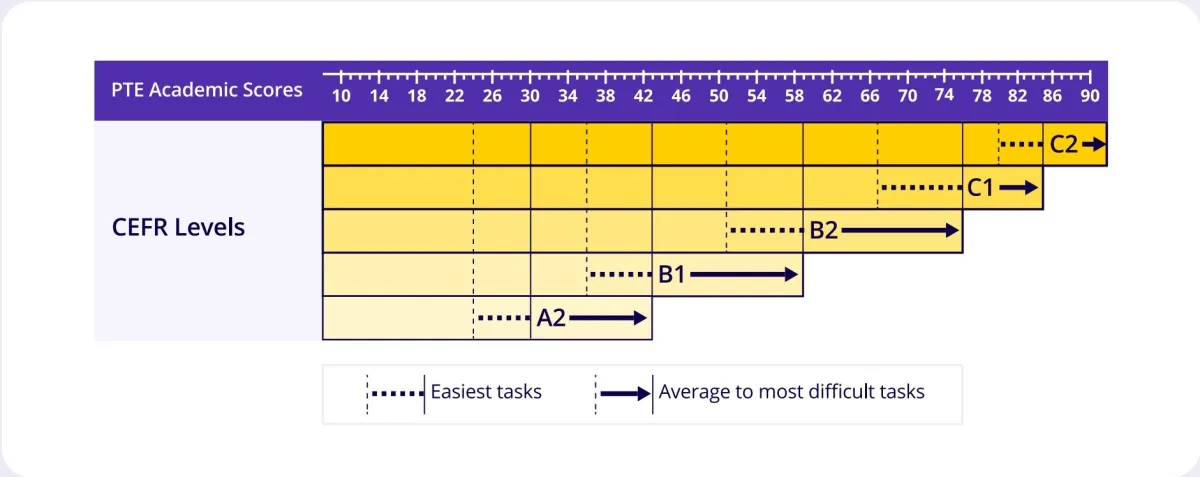
    PTE Academic to CEFR alignment chart
    Alignment of PTE Academic scores to the CEFR (Pearson, 2025).
    IELTSPTE OverallListeningReadingSpeakingWriting
    4.524–3026–3229–3514–2317–28
    5.031–3833–3936–4124–3829–40
    5.539–4640–4642–4739–5341–50
    6.047–5447–5248–5354–6551–59
    6.555–6253–5754–5866–7560–68
    7.063–7058–6359–6476–8269–76
    7.571–7864–6865–6983–8777–84
    8.079–8569–7470–7488–8985–89
    8.586–8975–8075–809090
    9.09081–9081–90

    Disclaimer: Any attempt to predict a score on one test based on another contains measurement error. Tests do not measure exactly the same construct.

    Want a personalised score plan?

    Our coaches map your weakest parameters and build a 7-day breakthrough plan.

    Explore PTE Courses