PTE Made Easy·HIWlistening Total time for all listening tasks: 31–39 minutes
Made Easy
Highlight Incorrect Words
Highlight Incorrect Words tests your ability to read a transcription on screen WHILE listening to the recording, and click on the words that DIFFER from what the speaker says. Each correct click scores 1 point — but each WRONG click loses 1 point (minimum score 0). On this page: an overview, the exam interface, top strategies (Before / During the test), common mistakes, points to remember and a full simulator with two practice items.
Chapter
Overview
Length of recording:
15–50 seconds
Number of incorrect words to find:
usually 4–7
Number of these tasks in each test:
2–3
Type of recording:
audio only — short academic monologue
Time limit for all listening tasks:
31–39 minutes
In Highlight Incorrect Words you read a transcription of an audio recording while you listen. Some words in the transcription are different from what the speaker says. You must click on each word that is different. Negative marking applies — wrong clicks subtract from your score, so only click words you are sure are wrong.
You will see instructions, an audio status box and a transcription of the recording.
When the audio plays, follow it word-by-word on the screen.
Click on every word in the transcription that does not match what you hear. Click again to de-select.
This task tests both your Listening and Reading skills — you read and listen at the same time.
Scored by AI
How Highlight Incorrect Words contributes to your score
Task
Highlight Incorrect Words
AI scoring
0%
Listening
0%
Reading
Your voice → analysed by AI → contributes 9% to Listening and 13% to Reading.
Watch — How To Answer Highlight Incorrect Words
Official PTE School walkthrough — how to answer Highlight Incorrect Words.
How the test screen works
The screen below is annotated with green markers (1–5). Press Start: a 6-second countdown plays, then the recording begins automatically. You CANNOT pause or replay it — only volume can be adjusted. Click any word in the transcription to highlight it (lime). Click the same word again to de-select it. Important: wrong clicks lose marks (minimum score 0), so only highlight words you are sure are wrong.
Highlight Incorrect Words — Exam Interface
Annotated walkthrough of the actual Pearson screen. 6-second countdown → recording plays once (no pause/replay) → click each word that differs from the audio → press Next.
PPTE Academic — Listening · Highlight Incorrect Words
Time Remaining 00:29:59 1 of 2
1Listening-section timer — counts down for ALL listening tasks. Don't spend more than ~1.5 minutes on this item.
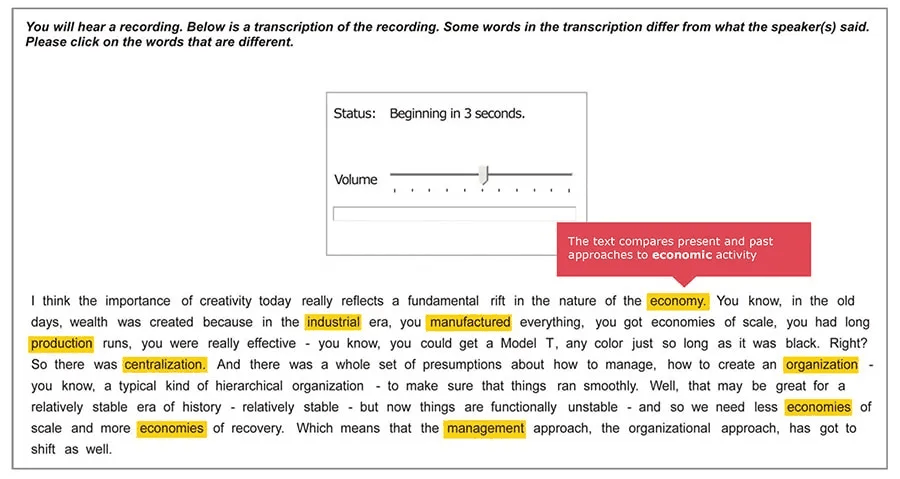
You will hear a recording. Below is a transcription of the recording. Some words in the transcription differ from what the speaker(s) said. Please click on the words that are different.2Read the prompt. The transcription on screen has a few words that DIFFER from the recording. Click each wrong word.
Audio Player
Press Start to begin
3Audio Player — plays automatically after a 6-second countdown. No pause, no replay. Only volume can be adjusted.
4Click any word to highlight it (lime). Click again to de-select. Wrong clicks are penalised — only click words you are sure are wrong.
0 highlighted
5'Next' becomes active ONLY after the audio finishes. Press it once you've highlighted all the words you think are incorrect.
Hover the green markers to see what each part of the screen does.
HIW 1
What this task tests
Skills assessed · 2 strands
Listening + Reading
Combined score weight
up to229 + 13 points
This task feeds two separate score strands. The AI evaluates different things for each — see the breakdown below.
Strand
Listening
up to9points
The AI scorer checks
Criterion
Following the audio word-for-word as it plays.
Criterion
Holding the spoken word in memory long enough to compare it with the on-screen word.
Criterion
Distinguishing between near-synonyms (e.g. proved vs. showed).
Strand
Reading
up to13points
The AI scorer checks
Criterion
Reading at the speaker's pace without falling behind.
Criterion
Resisting the urge to 'fix' words that look right on the page.
Criterion
Quickly resuming if you lose your place during playback.
Chapter
Top Strategies for Success in Highlight Incorrect Words
Two strategy phases — study both to maximise your score and avoid the negative-marking trap.
Get used to listening to native speakers
Listen to speakers of English who have different accents from places such as New Zealand, Ireland, the USA and so on. You will come across a variety of accents and dialects in the test as all of the audio is from authentic sources.
1
Pronunciation differences
Improving your understanding of how different speakers pronounce words can help. For example, some words are pronounced differently in British and American English, such as the word schedule, which could sound like:
• schedule (BrE) • skedule (AmE)
2
Connected speech
Get used to how speakers often say some groups of words faster than other groups, even in the same sentence. This is natural in English, but it means you have to pay careful attention while following the transcripts.
e.g. "We've conducted a number of…"
3
Word stress across accents
Pay attention to where word stress is placed differently by speakers from different countries. Try to learn differences like these:
• reSEARCH (AmE) / REsearch (BrE) • aDULT (AmE) / Adult (BrE)
Practice tips
Build the habit
1
Find some podcasts on general topics similar to those you may study in school or at university, or academic lectures, that have transcripts. With these:
2
Highlight all the key words in a short section of the transcript. Think about how they are pronounced and where the stress is placed within each word. Check this in a dictionary if you like.
3
Then play the recording and read the transcript at the same time, checking if you were correct.
4
Think about how the meaning of the extract would change if you changed any of the key words.
Quick tips — Do this, not that
Tip 01
You read at the same pace as the speaker.
You don't read ahead — your brain will auto-correct the 'wrong' word.
Tip 02
You click immediately when you hear a mismatch.
You don't pause to think — you'll fall behind and miss the next one.
Tip 03
You only click words you are SURE are wrong.
You don't guess — wrong clicks subtract from your score.
Tip 04
You de-select any uncertain clicks before pressing Next.
You don't 'add' words from memory after the audio ends.
Chapter
Practice now with your trainer
Practice — second item
Practise here without strict markers. Press Start: 6-second countdown → audio plays once (no pause / no replay) → click each word in the transcription that does not match what the speaker says. Press Show Answers to see the correct words and the explanation.
Practice question — Highlight Incorrect Words
Same Pearson-style screen as the real test. Listen, click each mismatch, then check your answers.
PPTE Academic — Listening · Highlight Incorrect Words
Time Remaining 00:29:59 2 of 2
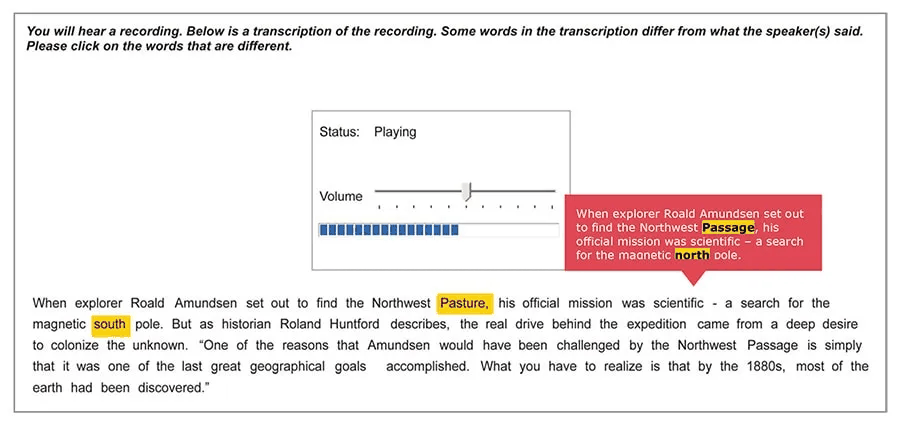
You will hear a recording. Below is a transcription of the recording. Some words in the transcription differ from what the speaker(s) said. Please click on the words that are different.
Audio Player
Press Start to begin
0 highlighted
HIW 2
Reflecting on your practice
1
Use the checklist below to decide what you did well and what you need to practise more.
2
Check the answer panel above. Did you find every substitution? Did you click any wrong words?
1. Reflection checklist
Private to you — tick each item you actually did. Saved on this device only.
0/7
Want a trainer to mark your listening practice?
Send a screenshot of your highlighted words on WhatsApp and our trainers will tell you exactly which substitutions you missed and which clicks were wrong.
Watch the most frequent mistakes test takers make in Highlight Incorrect Words — and how to avoid each one.
Points to remember
Listening tasks
1
Get familiar with each listening task type
Taking the time to get familiar with each listening task type is important. You only get to hear the recording once, so make sure you are always ready to listen with a clear goal in mind.
2
Manage your time across the whole section
Listening items (apart from Summarize Spoken Text) are not timed individually. You will have between 31 to 39 minutes for all the listening items. Make sure you practise managing your time effectively.
Quick Tips for a Better Score
Quickly read the transcription before you listen to focus on key words+
In the 10 seconds before the recording begins, you cannot read word-for-word, but you can skim the transcription.
Focus on the words that give you information: e.g., nouns ('economy'), adjectives ('industrial'), and verbs ('manufactured'). Decide what the general topic is. This will help you pick out words that do not fit this topic area, as you read and listen.
Follow the text with the cursor as you listen+
In this item type, you have to select the wrong words as the text is read. Don't try to make notes as you listen.
Move the cursor along the screen as the words are spoken, and click on any words that sound different from the words on the screen.
How this question is scored+
Partial credit with negative marking.
+1 point for each correctly identified incorrect word. −1 point for each word you click that is actually correct (negative marking). Minimum score is 0 — you cannot go below zero on a single item.
This question type contributes to BOTH your Listening AND Reading scores. Because of negative marking, only click words you are sure are wrong — don't guess.
These tasks are 1 or 0. No partial credit, no penalties. Always answer.
What raises your score
Take 2–3 keyword notes during the audio — choose by your notes, not memory.
For Highlight Correct Summary, scan summaries during playback for keywords.
What lowers it
Picking the summary with the most matching words instead of the right meaning.
Click a band to exploreMax 1
1
Correct response.
◾+1 for each correctly highlighted incorrect word.
◾−1 for each correct word you wrongly highlight (negative marking).
◾Minimum item score is 0 — wrong clicks can never push you below zero.
◾Contributes to BOTH Listening (up to 9 points) and Reading (up to 13 points).
◾Accuracy beats quantity — three confident correct clicks beats five clicks where two are wrong.