
PTE Made Easy·MCMA-Llistening Total time for all listening tasks: 31–39 minutes
    Made Easy

    Listening MCQ — Multiple Answers

    Listening MCQ Multiple Answers tests your ability to listen carefully to a short recording or watch a short video and pick more than one correct option from a list. Negative marking applies. On this page: an overview, the exam interface, top strategies (Before / During the test), common mistakes, points to remember and a full simulator with two practice items (one video, one audio).

    Chapter

    Overview

    • Length of video or audio:

      around 80–120 seconds

    • Number of correct responses:

      2 or more

    • Type of recording:

      audio or video, part of a lecture or conversation

    • Number of these tasks in each test:

      2–3

    • Total time for all listening tasks:

      31–39 minutes

    Multiple Choice, Multiple Answers (Listening) tests your ability to understand the main ideas, detailed information, purpose, organisation, and inference in a short academic lecture or conversation. Listen to a short audio clip (or watch a short video) and answer a multiple-choice question with more than one correct response. Click each option you want to select — selected options highlight yellow.

    • Read the question and options, listen to the recording, then choose at least two options you believe are correct.
    • Negative marking: you score 1 point for each correct option, but lose 1 point for each incorrect option — don't tick all as a guess.
    • You only hear the recording once. Take notes on your erasable noteboard while you listen.
    • The 'Next' button only becomes active AFTER the audio/video has finished playing.
    Scored by AI

    How Listening MCQ — Multiple Answers contributes to your score

    AI
    scoring
    0%

    Listening

    0%

    Overall

    Your voice → analysed by AI → contributes 5% to Listening and 1% to Overall.

    Watch — How To Answer Listening MCQ (Multiple Answers)

    Official PTE School walkthrough — how to answer Listening MCQ Multiple Answers.

    How the test screen works

    The screen below is annotated with green markers (1–5). Press Start: a 6-second countdown plays on a white screen, then the video begins automatically. You CANNOT pause or replay it — only volume can be adjusted. The 'Next' button only becomes active after playback ends.

    Listening MCQ — Multiple Answers — Exam Interface

    Annotated walkthrough of the actual Pearson screen. 6-second countdown → video plays once (no pause/replay) → answer the question → press Next.

    PPTE Academic — Listening · MCQ Multiple Answers
    Time Remaining 00:29:59 1 of 2
    1Listening-section timer — counts down for ALL listening tasks. Don't spend more than 1.5 minutes on this question.

    Watch the video and answer the question by selecting all the correct responses. You will need to select more than one response.2Read the prompt carefully. The phrase 'select more than one' tells you this is multiple-answer — negative marking applies.

    Press Start

    Press Start to begin

    3Media player. Plays automatically after a 6-second countdown. Only the volume can be adjusted — no pause, no replay.

    Which of the statements are correct about the speaker?

    4Click each option you think is correct. Selected options highlight yellow. Click again to deselect. click any option to toggle it
    0 selected
    5'Next' becomes active ONLY after the audio/video finishes. Press it once you've made your selections.

    Hover the green markers to see what each part of the screen does.

    MCQ 1

    What this task tests

    Skill assessed

    Listening

    Score weight

    up to4points

    The AI scorer checks

    Criterion

    Identifying the topic, theme or main ideas of a short lecture or conversation.

    Criterion

    Identifying supporting points and examples.

    Criterion

    Drawing inferences from what the speaker(s) say.

    Tone

    Analyzing the speaker's purpose, style, tone or attitude.

    Chapter

    Top Strategies for Success in Listening MCQ (Multiple Answers)

    Staying confident while listening

    It can be easy to panic when you don't understand a speaker. Practise for this scenario by listening to sources of English which you find challenging. Use the four strategies below.

    Four habits to build before test day so they feel automatic in the exam.

    Understand the topic first

    Make sure you first understand what the topic is. This will enable you to quickly decide what kind of content you will hear. For example, if the speaker is talking about a new government programme, you'll likely need to listen for targets, cost, problems, etc. You can also look for topic clues in the task options.
    Focus on the bigger picture

    Although detail should normally be your priority, with difficult audio tracks it's especially important not to be distracted by less important details. Just listen for the main ideas. An understanding of the bigger picture will often be enough to answer the questions in this task.

    Reconstruct words & phrases after

    Try to pick out individual words or phrases and reconstruct them after the recording has finished. For example, if you pick out the words decreased, coffee and Ecuador, you could guess that coffee sales from Ecuador have decreased.

    Listen to tone and intonation

    In MCQ Multiple Answers (Listening) tasks, you might need to identify the speaker's attitude or purpose. This is often revealed not only by what a speaker says but also how they say it. Tone can show whether they are agreeing, disagreeing, questioning, expressing irony, providing evidence, summarising, and so on.

    Practice tips

    Build the habit
    1. 1

      Find examples of lectures on topics you are interested in (you may be able to find some online). Listen to short sections of these lectures and identify the main points, along with any supporting details.

    2. 2

      Practise making statements about the lectures you have found.

      • Take a short section of the lecture (around one minute) and take notes on the speaker's main ideas. Write down keywords and use your own abbreviations or symbols. Then stop the lecture and try writing a sentence summarising what you heard.
      • Repeat this with another part of the lecture. However, this time take notes on the speaker's intention or purpose.
      • Try to write some more statements about the lecture. This could be about the organisation and connection of ideas, detailed information, purpose, tone, etc. Listen to the lecture again and check your statements. Is there anything you can change to make them better or more accurate?
    3. 3

      Try to find transcripts of the lectures (some universities have them).

      • Go through them and identify the main points of the talk, any examples or evidence referred to and any opposing arguments. Highlight the signal words that indicate them (e.g. We need to focus on …, The issue here is …, What we've discovered is …, For instance, To illustrate, On the contrary, etc.). Then listen for them in the audio or video.
      • Highlight any unfamiliar words in the transcript and guess their meaning from the words around them. Check your guess in a dictionary.

    Quick tips — Do this, not that

    • Tip 01

      You read the prompt and options BEFORE the recording starts.

      You don't wait passively for the audio — preview the options first.

    • Tip 02

      You select only options you can justify from what the speaker actually said.

      You don't tick every option as a 'safe' guess — negative marking will hurt you.

    • Tip 03

      You take selective keyword notes while listening.

      You don't try to transcribe the whole recording — you'll miss the meaning.

    • Tip 04

      You wait until the recording ends to confirm your answers, then press Next.

      You don't pick an option just because its words appear in the recording.

    Chapter

    Practice now with your trainer

    Practice — Design Thinking (audio)

    Practise here without strict markers. Press Start: 6-second countdown → audio plays once (no pause / no replay) → pick all the options you can justify from what the speakers say. Press Show Answers to see the correct selections and the explanation for each option.

    Practice question — Listening MCQ Multiple Answers (audio)

    Same Pearson-style screen as the real test. Listen, take notes, then pick every correct option.

    PPTE Academic — Listening · MCQ Multiple Answers
    Time Remaining 00:29:59 2 of 2

    Listen to the recording and answer the question by selecting all the correct responses. You will need to select more than one response.

    Press Start to begin

    Which of these sentences about design thinking are likely to be correct, from what the speakers say?

    0 selected
    MCQ 2

    Reflecting on your practice

    1
    Use the checklist below to decide what you did well and what you need to practise more. Set aside time to work on each area you want to improve.
    2
    Check the correct answers in the panel above (Model Answer). Were yours correct? Think about how you could improve.

    1. Reflection checklist

    Private to you — tick each item you actually did. Saved on this device only.

    0/7

    Want a trainer to mark your listening practice?

    Send a screenshot of your selections on WhatsApp and our trainers will explain the evidence behind each correct option — and why each wrong option doesn't fit.

    💬 Get evaluated on WhatsApp

    Common Mistakes in Listening MCQ — Multiple Answers

    Watch the most frequent mistakes test takers make in Listening MCQ Multiple Answers — and how to avoid each one.

    Points to remember

    Listening tasks
    • 1

      Get familiar with each listening task type

      Taking the time to get familiar with each listening task type is important. You only get to hear the recording once, so make sure you are always ready to listen with a clear goal in mind.

    • 2

      Manage your time across the whole section

      Listening items (apart from Summarize Spoken Text) are not timed individually. You will have between 31 to 39 minutes for all the listening items. Make sure you practise managing your time effectively.

    Quick Tips for a Better Score

    Take notes of the main points and supporting details

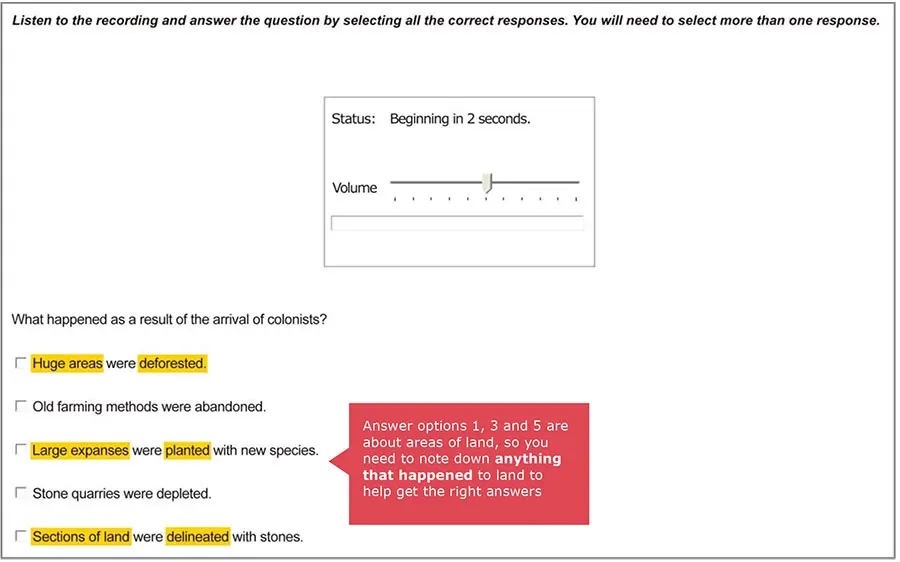
    In the seven seconds before the recording begins, read the question and get ready to take notes to help you answer. Taking notes is likely to be more helpful than trying to select options while you listen, because you may not hear the information in exactly the same order as the options.

    Note down details (e.g., times, places, things that happened) as well as the main points, because you will need to select more than one option.

    Example: notes for 'What happened as a result of the arrival of colonists?' — options about land highlighted
    Select for meaning, not just to match the words you hear

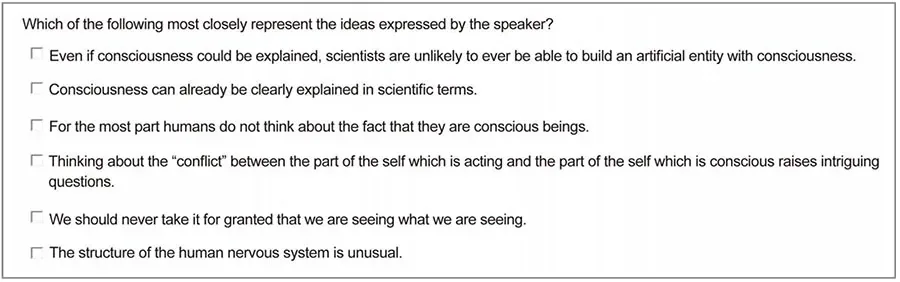
    Select the options that best match the meaning of what you heard. Don't just choose an option because it has the same words or phrases as the recording. Several options may use words from the recording but may not match the meaning of what you have heard.

    Example options for 'Which of the following most closely represent the ideas expressed by the speaker?'
    How this question is scored

    Your response is judged on your ability to understand specific details, facts and the speaker's purpose or attitude. This is a partial-credit item with negative marking: you score +1 for each correct option selected and −1 for each incorrect option selected. The minimum score is 0 — you can't go below zero. This question type contributes to your Listening score only.

    Listening MCMA and Highlight Incorrect Words both use negative marking. For HIW, every wrongly highlighted word costs you — only click words you’re sure differ from the audio.

    What raises your score
    • HIW: read along while listening; click only on a clear mismatch.
    • MCMA: tick options you heard explicitly, not options that ‘sound right’.
    What lowers it
    • Highlighting synonyms in HIW (the audio paraphrased — not an error).
    Click a band to exploreMax varies
    +1
    • Each correct response / each correctly identified incorrect word.
    • ◾Don't guess — an extra wrong tick cancels out a correct one.
    • ◾Only select options you are confident about based on your notes.
    • ◾See the full Scoring Guide for how partial credit and negative marking work across PTE.

    Keep going with Listening MCQ