PTE Made Easy·RAspeaking Reading time: 15 minutes 6–7 items
    Made Easy

    Read Aloud

    Read Aloud (RA) is a Speaking task where you read a short text out loud — how clearly and naturally you read shows how well you understand it. On this page: an overview of the task, top strategies for fluency and pronunciation, sample answers and common mistakes to practise with your trainer, the most repeated 2026 passages, and a guided task worksheet.

    Chapter

    Overview

    • Preparation time:

      30–40 seconds

    • Time to read the text aloud:

      30–40 seconds

    • Number of these tasks:

      6–7

    In read aloud tasks, you read a short text out loud. How well you can do this shows how well you understand the text.

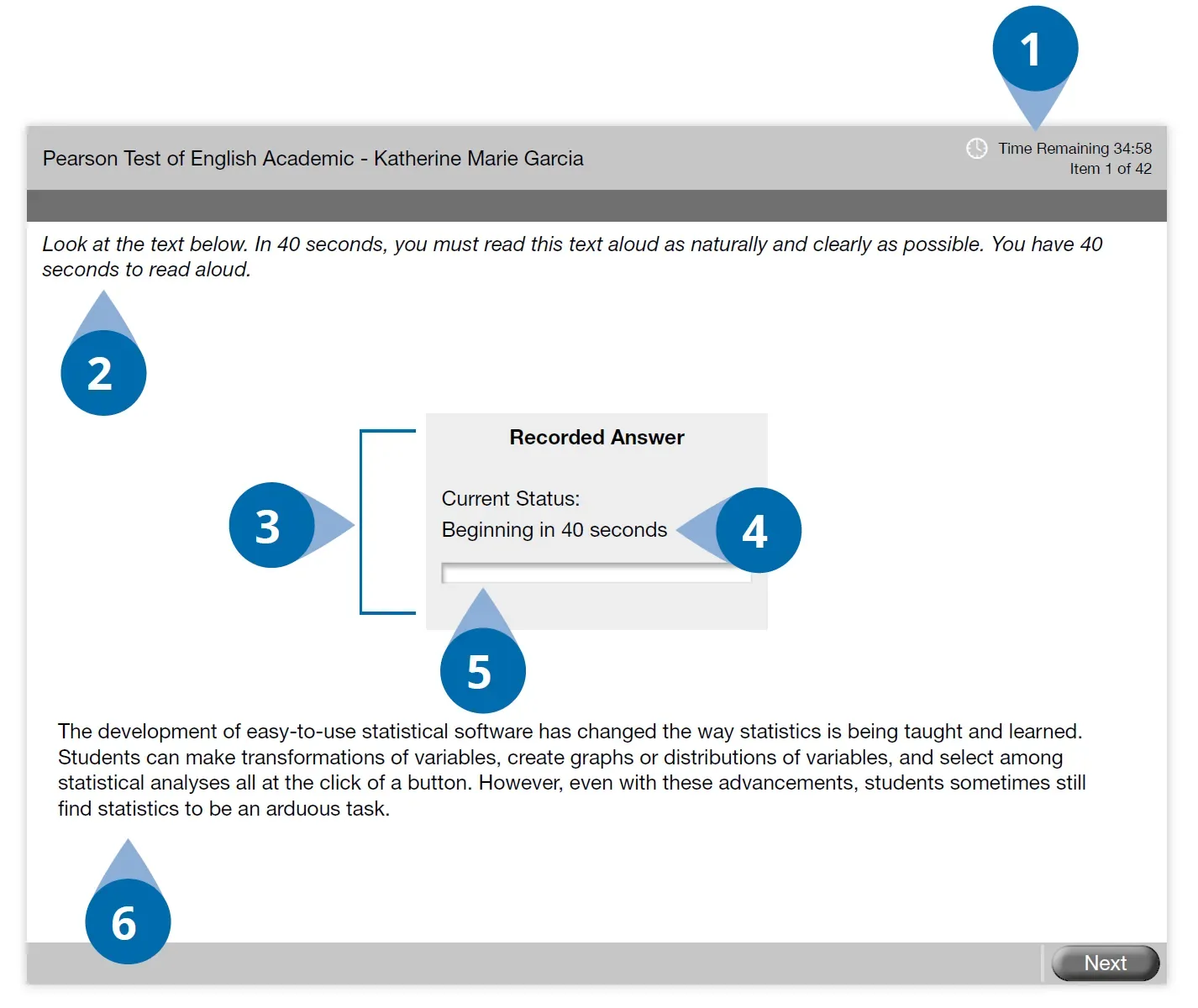
    • You will see instructions, a recording status box and a short text.
    • You have 30–40 seconds to prepare. Then read the text aloud into the microphone.
    • This task tests your speaking skills (pronunciation, intonation, rhythm, stress, linking and fluency).
    Scored by AI

    How Read Aloud contributes to your score

    AI
    scoring
    0%

    Speaking

    0%

    Overall

    Your voice → analysed by AI → contributes 9% to Speaking and 4% to Overall.

    Watch — Read Aloud walkthrough

    Official PTE School walkthrough — how to answer Read Aloud.

    How the test screen works

    The screen below is annotated with green markers (1–3) placed right next to the element they describe. Each marker is explained underneath — they cover the timer, instructions and the audio recorder.

    PPTE Academic - Candidate Name
    Time Remaining 00:27:59 1 of 27 (186543.2)
    1The timer shows the time left for all tasks in this part of the test.

    Look at the text below. In 40 seconds, you must read this text aloud as naturally and clearly as possible. You have 40 seconds to read aloud.2Read the task instructions carefully.

    Audio Recorder 3The recording status box tells you how much time you have left to prepare.

    Recording in 40

    0:00 / 0:40
    4After 30–40 seconds the box changes to ‘Recording’ and you have 30–40 seconds to read aloud. It then changes to ‘Completed’ and recording stops.

    Astronomers have recently discovered a large cloud of gas, in which many new stars are being formed, not far from our own solar system. While it would seem surprising that this phenomenon hadn't been previously noticed, the researchers explained that recent innovations in measuring the distance of gas clouds more accurately led to this discovery after older observations were reinterpreted.

    5Click ‘Next’ to go to the next task.

    Hover the green markers to see what each part of the screen does.

    What this task tests

    Skill assessed

    Speaking

    Score weight

    up to10points

    The AI scorer checks

    Fluency

    Speaking fluently at a natural speed

    Pronunciation

    Using clear pronunciation

    Intonation

    Using appropriate intonation (stress, rhythm and linking)

    Tone

    Using a tone appropriate to the reason for speaking (e.g. to inform or to explain)

    Chapter

    Top Strategies for Success in Read Aloud

    You can improve your fluency and get a better score by learning about pauses, linking, intonation and English rhythm.

    Split your sentences into sense groups

    In the task on the previous page, the first part of the starting sentence is a sense group: Astronomers have recently discovered a large cloud of gas … This is a sense group built around the verb 'discovered'. One word in this group is stressed more than the others ('gas') because this is the focus of the group.

    We don't pause between the words in a group when speaking. However, we usually leave a very short pause after one sense group before starting a new one. Pausing makes it easier for people to understand you because you can show you have finished an idea.


    Speak with a good rhythm

    In English, not every word or syllable is pronounced equally. Some words are pronounced weakly or disappear completely. We stress the words which carry the important information. This has an effect on rhythm patterns. There should be an equal amount of time between each stressed syllable. For example, if you say She has an interesting house or She has a big house, they should both take the same time. The word 'interesting' is pronounced so that it seems to only have three syllables and takes the same time to say as 'big'.

    Practise linking

    This is the smooth joining together of words within a sense group. For example, in have recently discovered, all three words are pronounced together without pausing. To link vowel sounds together, use a y or w sound (e.g. they·y·end, I·y·am, too·w·often, who·w·is).

    Use intonation

    The tone of your voice should usually fall at the end of each sense group.

    If two things are contrasted, the first usually has rising intonation and the other usually has falling intonation.

    In lists, each item usually has rising intonation except for the last, which has falling intonation.

    Practice Tips

    Follow To Succeed
    1. 1

      Record yourself on your mobile phone or other device as you practise reading aloud. Listen afterwards to your stress, intonation, rhythm and linking. If possible, compare the parts you found difficult to say with a fluent English speaker.

    2. 2

      Pay attention to meaning while reading. If you understand the main idea of a text and which words carry the key information, you will sound more natural.

    3. 3

      Learning academic vocabulary really helps with these tasks. Research shows that an excellent way to improve your vocabulary is to do lots of reading and listening on a range of different topics.

    4. 4

      Find short texts from websites or in books. Mark a / (slash) after each sense group. Then read them, practising intonation, stress and rhythm as above.

    5. 5

      Create lists of multi-syllable words. This can help you learn these patterns as well as the words themselves. For example, they could be in a table with words with a stressed first syllable in one column and words with a stressed second syllable in the next column, and so on.

    Quick tips — Do this, not that

    • Tip 01

      You only pause briefly.

      You don't pause for longer than three seconds. The microphone switches off after three seconds of silence.

    • Tip 02

      You read exactly what you see on screen.

      You don't skip any words. You won't get a mark if you miss a word or say a different one.

    • Tip 03

      You continue speaking, no matter what happens.

      You don't correct yourself or start again if you make a mistake.

    • Tip 04

      You use natural pronunciation. This leads to a better performance.

      You don't exaggerate your pronunciation or intonation. Speak as naturally as possible.

    • Tip 05

      You speak with a natural speed. It's fine to finish before the timer gets to zero.

      You don't slow down just to fill the time.

    • Tip 06

      You pause when you see a comma.

      You don't say the name of the punctuation marks ('comma', 'full stop', etc.).

    Chapter

    Practice now with your trainer

    Try Read Aloud 2 without a time limit

    Think about the strategies above. Then follow the task instructions and record your response. Press Start when you're ready.

    PPTE Academic - Candidate Name
    Time Remaining 00:27:59 1 of 27 (186543.2)

    Look at the text below. In 40 seconds, you must read this text aloud as naturally and clearly as possible. You have 40 seconds to read aloud.

    Audio Recorder

    Recording in 40

    0:00 / 0:40

    Project management is an area of growing importance across many fields, from engineering and information technology through to education and marketing. Therefore, if you study this exciting subject, you will be opening the doors to a career with plenty of variety and excellent opportunities.

    Reflecting on your practice

    Private to you — tick each item you actually did. Saved on this device only.

    0/10

    Model recording

    Listen to the model answer

    Compare this expert recording with your own. Notice the pacing, stress on content words, and intonation — then re-record until yours feels just as natural.

    Want a coach to score your attempt? Send your recording on WhatsApp and we'll reply with personalised feedback.

    Send on WhatsApp

    Common Mistakes in Read Aloud

    These pitfalls apply to every speaking task — watch the animation and read the fix.

    Don'tSpeaker without proper headset positionToo close

    Mic too close or off-position · voice distorts

    DoSpeaker with headset mic at correct distance~3 cm

    Headset on · mic ~3 cm from the side of mouth

    01

    Mic distance & volume

    Problem · Moving the mic mid-task or speaking louder/softer than your check causes uneven volume — the engine can't measure pronunciation reliably.

    Fix · Lock your mic position after the mic check. Keep the same distance from your mouth and the same speaking volume for every task.

    Don't
    Audio RecorderRecording…
    0:000:40
    Next

    Clicking Next while recording → answer cut off

    Do
    Audio RecorderCompleted
    0:000:40
    Next

    Wait for ‘Completed’, then click Next

    02

    Don't click 'Next' too soon

    Problem · Clicking Next while you're still talking cuts the recording. There's no way back — the answer is final.

    Fix · Wait until the recorder shows 'Completed'. Only then click Next, and only when you're sure you're finished.

    Watch — Common Mistakes in Read Aloud

    Tap play to watch — common pitfalls students make and how to avoid them.

    Most Repeated Read Aloud Questions in 2026

    Practise these passages aloud — they're frequently recycled in real exams.

    1. 1
      PPTE Academic
      Item 1 of 27 · 00:27:59

      Look at the text below. In 40 seconds, you must read this text aloud as naturally and clearly as possible.

      Audio Recorder

      Recording in 35

      When countries assess their annual carbon dioxide emissions, they count up their cars and power stations, but bush fires are not included — presumably because they are deemed to be events beyond human control. In Australia, Victoria alone sees several hundred thousand hectares burn each year; in both 2004 and more recently, the figure has been over 1 million hectares.

    2. 2
      PPTE Academic
      Item 2 of 27 · 00:27:59

      Look at the text below. In 40 seconds, you must read this text aloud as naturally and clearly as possible.

      Audio Recorder

      Recording in 35

      Every morning, no matter how late he had been up, my father rose at five-thirty, went to his study, wrote for a couple of hours, made us all breakfast, read the paper with my mother, and then went back to work for the rest of the morning. Many years passed before I realized that he did this for a living.

    3. 3
      PPTE Academic
      Item 3 of 27 · 00:27:59

      Look at the text below. In 40 seconds, you must read this text aloud as naturally and clearly as possible.

      Audio Recorder

      Recording in 35

      Research has shown that the gut microbiome is important for human physiology and health. Disturbances to the composition of the gut microbiome can be associated with chronic diseases such as gastrointestinal inflammatory disorders, and neurological, cardiovascular and respiratory illnesses. The human body has evolved strategies to ensure that a symbiotic relationship exists between the microbes in our gut and our cells.

    4. 4
      PPTE Academic
      Item 4 of 27 · 00:27:59

      Look at the text below. In 40 seconds, you must read this text aloud as naturally and clearly as possible.

      Audio Recorder

      Recording in 35

      Many papers you write in college will require you to include quotes from one or more sources. Even if you don't have to do it, integrating a few quotes into your writing can add life and persuasiveness to your arguments. The key is to use quotes to support a point you're trying to make rather than just include them to fill space.

    5. 5
      PPTE Academic
      Item 5 of 27 · 00:27:59

      Look at the text below. In 40 seconds, you must read this text aloud as naturally and clearly as possible.

      Audio Recorder

      Recording in 35

      There are perhaps three ways of looking at furniture: some people see it as purely functional and useful, and don't bother themselves with aesthetics; others see it as essential to civilized living and concern themselves with design and how the furniture will look in a room. In other words, function combined with aesthetics; and yet others see furniture as a form of art.

    6. 6
      PPTE Academic
      Item 6 of 27 · 00:27:59

      Look at the text below. In 40 seconds, you must read this text aloud as naturally and clearly as possible.

      Audio Recorder

      Recording in 35

      Humans need to use energy in order to exist. So it is unsurprising that the way people have been producing energy is largely responsible for current environmental problems. Pollution comes in many forms, but those that are most concerning, because of their impact on health, result from the combustion of fuels in power stations and cars.

    Quick Tips & Strategies for a Better Score

    Use punctuation to help you decide where to pause when you read

    You have 30–40 seconds to look at the text before the microphone opens, so use this time to break the text up into meaningful chunks, using the punctuation as a guide. This will show you the places where you can make a tiny pause and alter your intonation — going up when you begin reading a chunk and falling a little when you end a chunk. Using appropriate pausing helps you to read more fluently and give the full meaning of the text. This will improve your score.

    Look at where the pauses [ / ] are indicated in the example:

    Photography's gaze widened during the early years of the twentieth century /and, /as the snapshot camera became increasingly popular, /the making of photographs became increasingly available /to a wide cross-section of the public. /The British people grew accustomed to, /and were hungry for, /the photographic image.

    / = a brief pause between sense groups

    Stress the words that carry important information

    When you read the text, stress the words that help to convey meaning, by reading them in a slightly louder voice and adding emphasis to key syllables (e.g. development). Also, use rising and falling intonation patterns to show how the ideas are linked or are coming to an end.

    Stressed words are underlined; intonation rises ↑ and falls ↓.

    The development of easy-to-use statistical software has changed the way statistics is being taught and learned . Students can make transformations of variables , create graphs of distributions of variables , and select among statistical analyses all at the click of a button . However , with these advancements , students sometimes find statistics to be an arduous task .

    Underline = stressed word ↑ rising ↓ falling

    Read at a natural pace — don't read too quickly or too slowly

    Your fluency score depends on smooth, effortless delivery at a conversational speed. Reading too fast leads to slips, mispronunciations and missed pauses; reading too slowly breaks the rhythm and sounds hesitant. Aim for a steady, natural pace — the kind you'd use when reading a story aloud to someone. Keep moving forward even if you stumble on a word; long pauses or restarts hurt your oral fluency score more than a small mispronunciation.

    How Read Aloud is scored

    Read Aloud feeds three traits. Open each card below to see what raises and lowers your score, and explore every band descriptor.

    Content for speaking tasks is rated on whether you say the right things — the words from the prompt (Read Aloud, Repeat Sentence) or the right ideas with detail (Describe Image, Retell Lecture, Respond to a Situation). For Describe Image / Retell Lecture / SGD / RTAS, a human also reviews Content.

    What raises your score
    • Use a template only as a frame — fill it with the actual data/ideas.
    • For Describe Image: state type → main trend → 2 specific data points → comparison → conclusion.
    • For Retell Lecture: topic → 3–4 key points → speaker’s conclusion.
    • Paraphrase — don’t repeat the prompt word-for-word.
    What lowers it
    • Memorised template with no real content from the image / lecture.
    • Listing labels (“There is bar one, bar two, bar three…”) without describing.
    • Stopping after 15s when 30–40s is allowed.
    Click a band to exploreMax 5
    5Full, accurate, nuanced
    • Covers all key features/ideas with accurate detail and clear relationships; uses varied vocabulary.

    Coach tip · If you can’t see a number on the chart, describe the trend instead — never invent data.

    • ◾This item type contributes to Reading, Speaking, Oral Fluency and Pronunciation scores.
    • ◾Listening and Writing skills are not tested by this item type.

    Sample Answers & Feedback

    Listen to the three sample answers for the Astronomers task. Each recording is an example of a response given by test takers at C1, B2 or B1 competence level.

    Sample Answer 1 · C1C1
    +

    Feedback

    • ◾The test taker reads fluently at a natural speed and groups words together in a way that makes the meaning of the text clear. This shows that she has understood the content of the paragraph.
    • ◾The speaker places additional emphasis on gas, stars and surprising, to further help our understanding. Word stress and sentence stress (the pattern of stressed and unstressed words across a sentence) are correct.
    • ◾The test taker's pronunciation is native-like, making it easy for us to understand every word.
    • ◾No words are replaced or missed out.
    Sample Answer 2 · B2B2
    +

    Feedback

    • ◾The test taker reads the text at a natural pace. All words are pronounced accurately. No words are added, replaced or missed out.
    • ◾He uses appropriate intonation for the first half of the text, but has struggled with the rest. The test taker reads less fluently and groups words together in a way that does not make the meaning of the text clear. As a result, pausing and intonation are less appropriate in the second half.
    • ◾This contrasts with the way Sample Answer 1 has appropriately grouped words. Inappropriate grouping means the speaker has likely not fully understood the sentence.
    • ◾There are also three hesitations: one in front of phenomenon, one after measuring and a third before reinterpreted.
    Sample Answer 3 · B1B1
    +

    Feedback

    • ◾The test taker struggles to read the paragraph aloud. She speaks slowly and is clearly trying to sound as natural as possible. The speaker uses incorrect intonation, which refers to the voice rising or falling. This makes it difficult for us to understand the content.
    • ◾The test taker pronounces words correctly, but places incorrect word stress on words such as astronomers, solar system, phenomenon and researchers, which are probably not known to the speaker.
    • ◾From the reading performance it becomes clear that the test taker did not understand the meaning of the paragraph. This is, however, natural at B1 level as this text contains a lot of higher-level vocabulary, e.g. solar system, phenomenon, previously, researchers, innovations, accurately, discovery, observations, reinterpreted.
    Chapter

    Read Aloud Task Worksheet

    Practise word stress, grouping and pauses in compact click-to-open steps.

    1

    Task type & instructions

    Step 1 of 10

    +

    Warm-up: answer in one short line each before you study the screen.

    1. What will you read aloud?

    2. What skills are tested?

    3. How much preparation time will you get?

    4. What three things will you see on the screen?

    5. When do you start speaking?

    Progress bar at 0:12 / 0:35
    Progress bar at 0:12 / 0:35

    6. Look at the progress bar above. What is the status when it reaches the end?

    7. How long are the texts?

    2

    Label the screen

    Step 2 of 10

    +

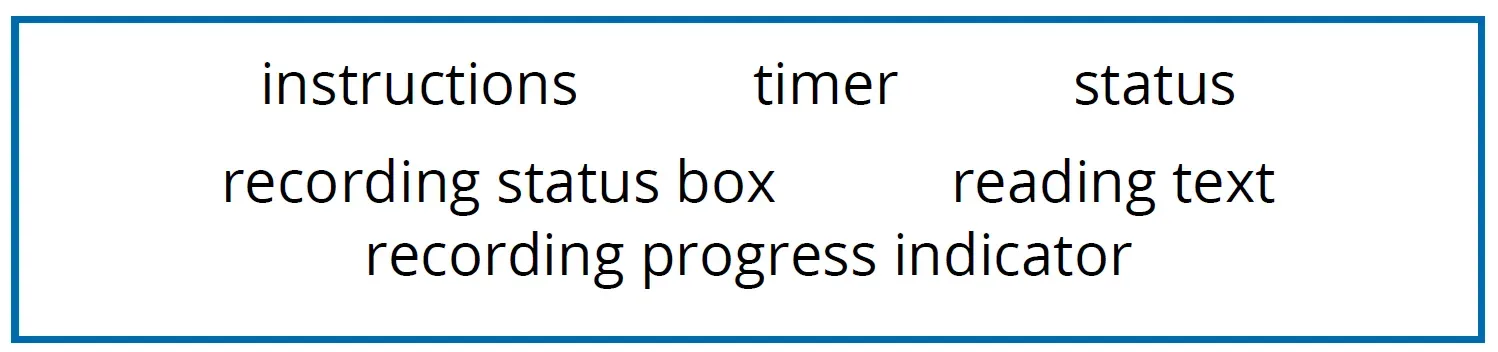
    Look at the diagram and label each numbered marker (1–6) using a word from the word bank.

    Pearson Read Aloud screen — six numbered markers (1–6).
    Pearson Read Aloud screen — six numbered markers (1–6).
    Word bank — pick one label per marker.
    Word bank — pick one label per marker.

    1. Marker 1

    2. Marker 2

    3. Marker 3

    4. Marker 4

    5. Marker 5

    6. Marker 6

    3

    Match concerns with advice

    Step 3 of 10

    +

    Match concerns 1–4 with advice a–d.

    Common distractions before or during the test.
    Common distractions before or during the test.
    1.I'm embarrassed because everyone will be able to hear me.
    2.There's not enough time, so I need to speak quickly.
    3.I don't want to disturb others, so I'll speak quietly.
    4.I don't know how to approach the task.

    Options

    • a.Pretend you are speaking to an audience.
    • b.Speak normally so the computer can pick up your voice.
    • c.Speak at your normal pace or you'll make a mistake.
    • d.No one is listening to you. They are focusing on themselves.
    4

    Pick four useful prep strategies

    Step 4 of 10

    +

    Tick the four strategies you'd use in your 30–40s prep.

    Tick 4 · Selected 0/4

    5

    Break words into syllables

    Step 5 of 10

    +

    Example: academic = ac-a-dem-ic. Type the syllables.

    development
    transformation
    statistical
    distribution
    advancement
    6

    Underline the stressed syllable

    Step 6 of 10

    +

    Look at the words from Exercise 5 and click the stressed syllable.

    1. development

    2. transformation

    3. statistical

    4. distribution

    5. advancement

    7

    Highlight stressed key words

    Step 7 of 10

    +

    🎧 Model audio

    Click the words you'd stress when reading aloud. Listen to the model audio above and check.

    8

    Mark places to pause

    Step 8 of 10

    +

    Click between words to insert / where you'd pause. Example: The development / of easy-to-use statistical software / has changed …

    Thedevelopmentofeasy-to-usestatisticalsoftwarehaschangedthewaystatisticsisbeingtaughtandlearnt.Studentscanmaketransformationsofvariables,creategraphsofdistributionsofvariables,andselectamongstatisticalanalysesallattheclickofabutton.However,evenwiththeseadvancements,studentssometimesstillfindstatisticstobeanarduoustask.

    9

    Practise reading aloud — Photography

    Step 9 of 10

    +

    Read aloud and record yourself: ‘Photography's gaze widened during the early years of the twentieth century, and as the snapshot camera became increasingly popular, the making of photographs became increasingly available to a wide cross-section of the public. The British public grew accustomed to, and were hungry for, the photographic image.’

    🎧 Model recording

    10

    Apply it to your own materials

    Step 10 of 10

    +

    Read a short text from a book or article and record yourself. Reflect:

    1. What went well?

    2. What will you focus on next time?

    Recording is local-only

    All audio is captured in your browser using the MediaRecorder API. Nothing is uploaded — refresh the page to clear it. Send us the URLs for the walkthrough video, model audio and three sample-answer recordings whenever you're ready.

    Keep going with Read Aloud

    Useful Language for Speaking

    Open the Speaking Useful-Language toolkit

    A trainer-ready resource covering academic style, collocations, signposting, cause/effect, comparison, image description, hypothesis and estimation — every exercise has a hidden suggested answer. Use it for every speaking task.

    Open speaking resources