
PTE Made Easy·FIB-DADreading Total time for reading tasks: 29–30 minutes 4–5 items per test
    Made Easy

    Fill in the Blanks (Drag & Drop)

    Fill in the Blanks (Drag & Drop) is a Reading task. You see a passage with several blanks and a box of words below. Drag each word into the correct blank — the word bank ALWAYS contains exactly 3 more words than blanks (the extras are distractors). On this page: an overview, the Pearson exam interface, top strategies, common mistakes, points to remember and a full drag-and-drop simulator.

    Chapter

    Overview

    • Length of text:

      up to 80 words

    • Number of blanks:

      4 – 5

    • Words in the bank:

      blanks + 3 extras

    • Number of these tasks:

      4 – 5

    • Total time for reading tasks:

      29 – 30 minutes

    Drag and drop words from the box into the gaps in the text. There are always more words than gaps — so you will not use them all. You can drag a word out of a blank to remove it, or swap one word for another at any time.

    • Click a word, hold the mouse, drag it onto a blank.
    • Drag a word from one blank to another to swap your choice.
    • Drag a word out of a blank back to the box to clear that blank.
    • Rule: words in the bank = number of blanks + 3 extras (5 blanks → 8 words).
    Scored by AI

    How FIB Drag & Drop contributes to your score

    AI
    scoring
    0%

    Reading

    0%

    Overall

    Your voice → analysed by AI → contributes 20% to Reading and 6% to Overall.

    Watch — How To Answer FIB: Reading (Drag & Drop)

    Walkthrough — how to drag words into the blanks for the Reading FIB task.

    How the test screen works

    The screen below is annotated with green markers (1–5). Hover each one — they cover the timer, the instructions, the passage with blanks, the WORD BANK below the passage, and the Next button. The bank ALWAYS shows 3 more words than there are blanks, so don't expect to use every word.

    FIB Drag & Drop — Exam Interface

    Annotated walkthrough of the actual Pearson screen. Drag a word from the bottom box into any blank. Drop a word back to the box to clear that blank. Press 'Show answers' to check.

    PPTE Academic - Candidate Name
    Time Remaining 00:29:59 1 of 5 (86786.2)
    1Reading-section timer — counts down for ALL reading tasks. Don't spend more than 2–3 minutes here.

    In the text below some words are missing. Drag words from the box below to the appropriate place in the text. To undo an answer choice, drag the word back to the box below the text.2Read the instructions: drag a word from the bottom box into each blank.

    Second, they connect scientists to the general 1. Anyone with internet access can 2 a researcher's blog and follow the latest discussion in their field. Scientific papers are now beginning to 3 blogs as references, and that recognition further 4 the credibility of online writing.
    3The text. Each blue dotted slot is a blank — drop a word onto it.
    Word bank · 7 of 7 available(always = blanks + 3 extra distractors)
    4Word bank — always contains exactly 3 MORE words than blanks (5 blanks → 8 words). The extras are distractors.
    0 / 4 blanks filled
    5Click 'Next' when you've filled every blank. You can drag a word back to the bank to remove it.

    Hover the green markers to see what each part of the screen does.

    What this task tests

    Skill assessed

    Reading

    Score weight

    up to19points

    The AI scorer checks

    Criterion

    Identifying words appropriate to the context.

    Criterion

    Using collocations to recognise the right word for each blank.

    Grammar

    Using grammar (part of speech, verb form, articles) to rule out wrong options.

    Comprehension

    Inferring meaning from context.

    Chapter

    Top Strategies for Success in FIB (Drag & Drop)

    Identifying key words

    There are lots of ways to identify the missing words in a text. Look at the worked example below — the bold key words next to each blank tell you the topic of the missing word, and the grammar around the blank tells you what kind of word fits.

    The twentieth century commenced with an unprecedented surge of change within art. There was a   in subject matter from the real world of human activity and the artist's own mind, with artists taking on a much more   role as influencers within society.

    Apply these three lenses, in order, to every blank you face.

    When you first read the text

    To understand its general meaning, it's useful to identify the key words. These give particular meaning and context to what you are reading. Look at the key words in bold next to the blanks. In the example, the key words are art and artists: there was a change. The artists' subject matter (the things they chose to make art about) changed. It used to be about the 'real world' of human activity and changed to being about the artist's own mind. Also, their role in society changed.

    Now think about what kind of words could fill the blanks

    The first blank needs a noun and is probably related to the topic of change. The second blank also needs a noun and is related to the topic of human activity. The third blank needs an adjective (because it follows more and is related to the topic of the artist's role).

    Difficult words

    There may be some words in the paragraph that you don't understand. Decide if they are important to understand. If they are, read around them and try to guess the meaning from context. For example, look at the word surge and the words around it. From the context, it should be possible to work out that it has a meaning of sudden rise.

    Practice tips

    Follow To Succeed
    1. 1

      Practise by finding a short text and trying to understand the main ideas. Do the following:

    2. 2

      Highlight key words and try to identify the purpose of the text and any conclusions.

    3. 3

      Write a short summary of the text in your own words.

    4. 4

      Delete some key words. These should be 'content' words (nouns, adjectives, important verbs) and not smaller words such as the or with. They should be words that are important to the meaning of the sentence.

    5. 5

      Then think of all the different words that could fit in the blank you created. They need to be words that would make sense and be grammatically correct in that blank.

    Quick tips — Do this, not that

    • Tip 01

      You apply collocations + grammar + meaning, in that order.

      You don't pick a word just because it 'sounds nice'.

    • Tip 02

      You re-read each filled sentence end to end.

      You don't move on after dropping a word without checking it fits.

    • Tip 03

      You use the easy blanks to thin out the bank for hard ones.

      You don't fill blanks left-to-right if some are obviously easier.

    • Tip 04

      You always fill every blank — guess if needed.

      You don't leave blanks empty. There is no negative marking.

    Chapter

    Practice now with your trainer

    Practice — Underwater volcanoes

    Try this FIB Drag & Drop without help. Skim, fill the easy blanks, then go back. After you finish, use the reflection checklist below and check the answer key — don't peek before you've tried!

    Practice question — FIB Drag & Drop

    Same Pearson-style screen. 5 blanks → 8 words in the bank (3 are distractors).

    PPTE Academic - Candidate Name
    Time Remaining 00:29:59 2 of 5 (86786.2)

    In the text below some words are missing. Drag words from the box below to the appropriate place in the text. To undo an answer choice, drag the word back to the box below the text.

    Most volcanic activity on Earth takes place under the oceans. Some of these underwater volcanoes erupt thousands of times each year, 1 huge amounts of lava onto the deep sea floor. But because they are hidden from view, scientists have struggled to 2 their behaviour. New high-resolution sonar maps now 3 researchers to track the eruptions in real time, providing fresh 4 into how the ocean crust is formed and how volcanic gases shape global 5.
    Word bank · 8 of 8 available(always = blanks + 3 extra distractors)
    0 / 5 blanks filled

    Reflecting on your practice

    Private to you — tick each item you actually did. Saved on this device only.

    0/7

    Check the answersClick to reveal

    Were your answers correct? Try to think about how you could improve.

    Answer key (in order of blanks):
    1. spilling  ·  2. monitor  ·  3. allow  ·  4. insight  ·  5. climate

    Unused (distractor) words: weather, predict, throwing.

    Common Mistakes in FIB Drag and Drop

    Watch the most frequent mistakes in FIB Reading drag-and-drop — and how to avoid each one.

    Points To Remember

    Reading Tasks
    • 1

      No special knowledge required

      All clues you need are in the text. Don't worry if the topic is unfamiliar — read for grammar and collocation, not subject expertise.

    • 2

      13–18 reading tasks total

      The Reading section has 13–18 tasks and ONE shared timer. Spend no more than 2 minutes on this task.

    • 3

      Partial-credit scoring

      You get 1 point for every blank filled correctly. Wrong words score 0 — but there is no negative marking, so always fill every blank.

    • 4

      Bank rule = blanks + 3

      The word bank ALWAYS contains exactly 3 more words than blanks. 4 blanks → 7 words. 5 blanks → 8 words. Three of them are distractors designed to look right.

    Chapter

    Most Repeated FIB Drag & Drop Questions in 2026

    Practise the most-repeated 2026 FIB Drag & Drop questions

    Each one opens in the FULL Pearson-style drag-and-drop simulator. Drag from the box into each blank, then press 'Show answers' to check.

    MR-2026 #1 — Brain plasticity & learning

    Most-repeated 2026 FIB Drag & Drop #1. Word bank = blanks + 3 extras.

    PPTE Academic - Candidate Name
    Time Remaining 00:29:59 1 of 3 (90100.1)

    In the text below some words are missing. Drag words from the box below to the appropriate place in the text. To undo an answer choice, drag the word back to the box below the text.

    The human brain is remarkably 1 — it continues to form new connections throughout life. When we learn a new skill, neurons 2 new pathways and existing pathways are strengthened. This process, known as plasticity, was once thought to 3 only in childhood, but recent research has shown that adults can also 4 significant changes in their brain structure through deliberate practice.
    Word bank · 7 of 7 available(always = blanks + 3 extra distractors)
    0 / 4 blanks filled

    MR-2026 #2 — Coral reefs under threat

    Most-repeated 2026 FIB Drag & Drop #2. Word bank = blanks + 3 extras.

    PPTE Academic - Candidate Name
    Time Remaining 00:29:59 2 of 3 (90101.2)

    In the text below some words are missing. Drag words from the box below to the appropriate place in the text. To undo an answer choice, drag the word back to the box below the text.

    Coral reefs are among the most 1 ecosystems on the planet, supporting around a quarter of all marine species. Yet rising sea temperatures and ocean acidification are causing widespread 2, with corals expelling the algae that give them colour and food. Conservationists are now racing to 3 resilient strains in laboratories before reefs disappear 4.
    Word bank · 7 of 7 available(always = blanks + 3 extra distractors)
    0 / 4 blanks filled

    MR-2026 #3 — Renewable energy in remote areas

    Most-repeated 2026 FIB Drag & Drop #3. Word bank = blanks + 3 extras.

    PPTE Academic - Candidate Name
    Time Remaining 00:29:59 3 of 3 (90102.3)

    In the text below some words are missing. Drag words from the box below to the appropriate place in the text. To undo an answer choice, drag the word back to the box below the text.

    In many remote villages, electricity is still produced by diesel generators which are noisy, polluting and expensive to 1. Small solar grids are now offering a cleaner and cheaper 2. A single rooftop array can 3 enough energy for an entire household, and surplus power can be stored in batteries for use after 4. Governments are increasingly providing subsidies to 5 the switch.
    Word bank · 8 of 8 available(always = blanks + 3 extra distractors)
    0 / 5 blanks filled

    Quick Tips for a Better Score

    Think about words that you often see or hear together

    Remember that some words often go together to form a familiar phrase. This is called 'collocation'. Using collocation can help you recognize the correct word for each blank.

    For example, the phrase 'the general public' is a common collocation, so you can quickly see that 'public' might be a good choice for the first blank in the sentence below:

    Example of collocation — 'the general public' fits the blank in the sentence with the word bank below
    Use your knowledge of grammar to help you select the correct word

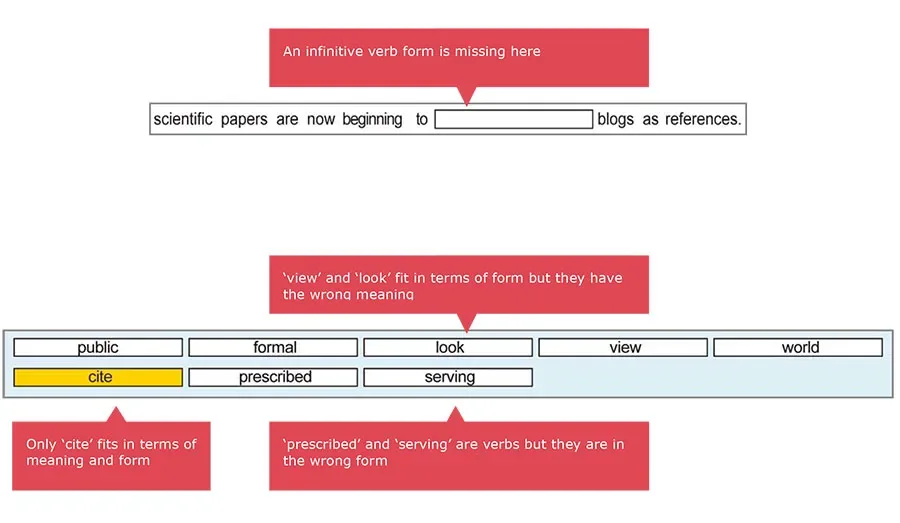
    Read around the blank in the text and decide what part of speech the missing word is. In the example below, 'beginning to' tells you that an infinitive verb form is missing (to + verb). Next look at the answer options and rule out any words that are not the right part of speech — e.g. 'world' is a noun and 'formal' is an adjective. Also rule out any verbs that are not in the infinitive form.

    Finally, choose the word that has the correct meaning from the words that are left: 'view' and 'look' mean 'see', but we 'quote' or 'cite' references — so only 'cite' fits the blank:

    Eliminate words by part of speech and meaning — only 'cite' fits in form and meaning
    How this question is scored

    Your response is judged on your ability to use context and grammatical cues to identify the missing words. If all blanks are filled correctly, you receive the maximum score. If one or more are wrong, partial credit applies — 1 point per correctly filled blank. This question type affects the scoring of only Reading.

    RW-Fill in the Blanks, R-Fill in the Blanks (drag & drop) and Reorder Paragraph all use partial credit. There is no penalty for wrong answers — but for Reorder, only correctly adjacent pairs count, so one misplaced paragraph can cost two pairs.

    What raises your score
    • Always fill every blank — no penalty for guessing.
    • For Reorder, find the topic sentence first (no pronouns, introduces the subject).
    • Use grammar clues for blanks: article → noun, ‘to’ → infinitive.
    What lowers it
    • Leaving blanks empty when unsure.
    • Picking words by meaning alone, ignoring grammar/collocation.
    Click a band to exploreMax 1
    1
    • Each correctly completed blank / each correct adjacent pair.

    Coach tip · Reorder: chain by referring expressions (this, these, such, the latter).

    • ◾Maximum score = number of blanks (4 blanks → 4 points; 5 blanks → 5 points).
    • ◾Each blank is independent — a wrong word costs only that blank, not the ones around it.
    • ◾There is no negative marking — always fill every blank.
    • ◾The word bank always has 3 distractors — don't expect to use every word.

    Keep going with Fill in the Blanks (Drag & Drop)