PTE Made Easy·MCMA-Rreading Total time for reading tasks: 29–30 minutes 2–3 items per test
    Made Easy

    Reading MCQ — Multiple Answers

    Reading MCQ Multiple Answers tests your ability to read carefully and pick more than one correct option from a list. Watch out — negative marking applies. On this page: an overview, the exam interface, top strategies (Before / During the test), common mistakes, points to remember and a full simulator.

    Chapter

    Overview

    • Length of text:

      up to 350 words

    • Correct answers:

      more than one

    • Options shown:

      5

    • Number of these tasks:

      2–3

    • Total time for reading tasks:

      29–30 minutes

    Read a short academic text and answer a multiple-choice question with more than one correct response. Click each option you want to select — selected options highlight yellow.

    • There is more than one correct answer — read the question carefully (the prompt tells you).
    • Negative marking: you score 1 point for each correct option you select but lose 1 point for each incorrect option.
    • Don't tick all of them as a guess — that will lose you points.
    • The reading-section timer counts down for ALL reading tasks — manage your pace.
    Scored by AI

    How Reading MCQ — Multiple Answers contributes to your score

    AI
    scoring
    0%

    Reading

    0%

    Overall

    Your voice → analysed by AI → contributes 5% to Reading and 1% to Overall.

    Watch — How To Answer Reading MCQ (Multiple Answers)

    Official PTE School walkthrough — how to answer Reading MCQ with multiple correct answers.

    How the test screen works

    The screen below is annotated with green markers (1–5). Hover each one — they cover the reading-section timer, the prompt, the passage, the option checkboxes (click to toggle, click again to deselect) and the Next button. Pick every option you think is correct, then press Next.

    Reading MCQ — Multiple Answers — Exam Interface

    Annotated walkthrough of the actual Pearson screen. Click any option to select it (yellow highlight). Hover the green markers to see what each part of the screen does. Press Show Answers when you're ready to check.

    PPTE Academic - Candidate Name
    Time Remaining 00:29:59 1 of 2 (90123.4)
    1Reading-section timer — counts down for ALL reading tasks. Don't spend more than 2–3 minutes on this question.

    Read the text and answer the question by selecting all the correct responses. You will need to select more than one response.2Read the prompt carefully. The phrase 'select more than one' tells you this is multiple-answer — negative marking applies.

    The Turks and Caicos Islands are a multi-island archipelago at the southern tip of the Bahamas chain, approximately 550 miles south-east of Florida. The islands are an overseas territory of the United Kingdom although they exercise a high degree of local political autonomy. The economy of the islands rests mainly on tourism, with some contribution from offshore banking and fishing. Primary schooling is divided into eight grades, with most pupils entering at the age of four years and leaving at twelve. After two kindergarten years, Grades 1–6 are covered by a graded curriculum in maths, language and science that increases in difficulty as pupils get older. There is little repetition and pupils are expected to progress through primary school in their age cohorts. At the end of primary schooling, pupils sit an examination that serves to stream them in the secondary school setting. Primary and secondary school enrolment is virtually universal. There are a total of ten government primary schools on the islands. Of these, seven are large enough to organize pupils into single-grade classrooms. Pupils in these schools are generally grouped by age into mixed ability classes. The remaining three schools, because of their small pupil numbers, operate with multigrade groupings. They serve communities with small populations whose children cannot travel to a neighbouring larger primary school. Pupils in these classes span up to three grade and age groups. As far as classroom organization is concerned, the multigrade and monograde classrooms are similar in terms of the number of pupils and the general seating arrangements, with pupils in rows facing the blackboard. There is no evidence that the multigrade teachers operate in a particularly resource-poor environment in the Turks and Caicos Islands. This is in contrast to studies conducted in other developing country contexts.
    3The passage. Skim once for the main idea, then scan for repeated keywords from the options.

    According to the text, which of the following statements can be concluded about primary classes in the Turks and Caicos Islands?

    4Click each option you think is correct. Selected options highlight yellow. Click again to deselect. Press Show Answers to see the result. click any option to toggle it
    0 selected
    5Click 'Next' once you've selected your answers. There's no Submit — Next confirms and moves on.

    Hover the green markers to see what each part of the screen does.

    What this task tests

    Skill assessed

    Reading

    Score weight

    up to5points

    The AI scorer checks

    Criterion

    Identifying the topic, theme or main ideas of a text.

    Criterion

    Identifying supporting points and examples.

    Criterion

    Drawing inferences from a text.

    Tone

    Analyzing the writer's purpose, style, tone or attitude.

    Chapter

    Top Strategies for Success in Reading MCQ (Multiple Answers)

    Two reading skills are tested

    Skimming — reading quickly to get the main idea.
    Scanning — searching for specific details (names, numbers, key words). Reading MCQ Multiple Answers rewards both: skim the passage first, then scan back for the details that match each option.

    Two reading skills

    Skimming vs Scanning

    Two different ways of reading — both rewarded in MCQ Multiple Answers.

    Skimming

    Aim — find the main ideas

    • Short texts: read the first & last sentence of each paragraph.
    • Longer texts: skim the introduction & conclusion.
    • ~30 seconds — get the gist, no full reading.

    Scanning

    Aim — find specific details

    • Hunt for names, numbers, dates, key words.
    • Don't read every word — let your eye jump to matches.
    • Perfect for matching options to evidence in the text.
    How to use both
    1. Skim once for the main idea2. Read the question + options3. Scan back for evidence

    Practise these three habits before test day so they feel automatic in the exam.

    Read short academic texts

    Find short texts (two to five paragraphs) from academic books or magazines. Ask yourself: What conclusions can be drawn? Identify topic sentences and the relationships between ideas.

    Build a 2–3 minute habit

    Time yourself: spend no more than 2–3 minutes on each text. The reading section is timed for all tasks — pace matters more than perfection.

    Expand vocabulary with synonyms

    Use a thesaurus to learn synonyms. The correct option often paraphrases the text rather than copying it word-for-word. Record example sentences for each new word.

    Practice Tips

    Build the habit
    1. 1

      Identify cohesive devices. Highlight a word like this or it and find what it refers back to. Or find a repeated idea/synonym chain through a paragraph.

    2. 2

      Practise within a time limit — 2–3 minutes per task is the sweet spot.

    3. 3

      Deal with unfamiliar words: 1) Check if the word is explained nearby; 2) Try to guess from context; 3) Decide if you really need to understand it — if not, ignore it.

    4. 4

      Read the question first to know what to look for, then read the options, then read the text with that purpose.

    Quick tips — Do this, not that

    • Tip 01

      You read the question first to know what to look for.

      You don't read the text before knowing the question.

    • Tip 02

      You select only options you can justify from the text.

      You don't tick every option as a 'safe' guess — negative marking will hurt you.

    • Tip 03

      You think about why the options you didn't pick are incorrect.

      You don't pick an option just because its words appear in the text.

    • Tip 04

      You keep an eye on the timer to leave room for the rest of the reading section.

      You don't spend more than 2–3 minutes on a single MCQ Multiple Answers task.

    Chapter

    Practice now with your trainer

    Practice — Turks & Caicos primary classes

    Practise here without strict markers. Read the prompt, skim the passage, then pick all the options you can justify. Press Show Answers to see the correct selections and what the negative marking would have cost you.

    Practice question — Reading MCQ Multiple Answers

    Same Pearson-style screen as the real test. Pick every correct option, then press Show Answers.

    PPTE Academic - Candidate Name
    Time Remaining 00:29:59 1 of 2 (90123.4)

    Read the text and answer the question by selecting all the correct responses. You will need to select more than one response.

    The Turks and Caicos Islands are a multi-island archipelago at the southern tip of the Bahamas chain, approximately 550 miles south-east of Florida. The islands are an overseas territory of the United Kingdom although they exercise a high degree of local political autonomy. The economy of the islands rests mainly on tourism, with some contribution from offshore banking and fishing. Primary schooling is divided into eight grades, with most pupils entering at the age of four years and leaving at twelve. After two kindergarten years, Grades 1–6 are covered by a graded curriculum in maths, language and science that increases in difficulty as pupils get older. There is little repetition and pupils are expected to progress through primary school in their age cohorts. At the end of primary schooling, pupils sit an examination that serves to stream them in the secondary school setting. Primary and secondary school enrolment is virtually universal. There are a total of ten government primary schools on the islands. Of these, seven are large enough to organize pupils into single-grade classrooms. Pupils in these schools are generally grouped by age into mixed ability classes. The remaining three schools, because of their small pupil numbers, operate with multigrade groupings. They serve communities with small populations whose children cannot travel to a neighbouring larger primary school. Pupils in these classes span up to three grade and age groups. As far as classroom organization is concerned, the multigrade and monograde classrooms are similar in terms of the number of pupils and the general seating arrangements, with pupils in rows facing the blackboard. There is no evidence that the multigrade teachers operate in a particularly resource-poor environment in the Turks and Caicos Islands. This is in contrast to studies conducted in other developing country contexts.

    According to the text, which of the following statements can be concluded about primary classes in the Turks and Caicos Islands?

    0 selected

    Reflecting on your practice

    Private to you — tick each item you actually did. Saved on this device only.

    0/6

    Want a trainer to mark your reading practice?

    Send a screenshot of your selections on WhatsApp and our trainers will explain the evidence behind each correct option — and why each wrong option doesn't fit.

    💬 Get evaluated on WhatsApp

    Common Mistakes in Reading MCQ — Multiple Answers

    Watch the most frequent mistakes test takers make in Reading MCQ Multiple Answers — and how to avoid each one.

    Points To Remember

    Reading Tasks
    • 1

      Negative marking applies

      You score 1 point for each correct option you tick, but you LOSE 1 point for each wrong option you tick. Don't select all options as a guess — leave it blank if you really don't know.

    • 2

      15–20 reading tasks total

      The Reading section has 15–20 tasks. The timer counts down across ALL reading tasks together — when you're satisfied with your answer, click 'Next' to move on.

    Quick Tips for a Better Score

    Make sure you know how the task is scored

    Read the instructions carefully. Remember that more than one option is correct in this type of multiple-choice item. You will score marks for any correct options but you will lose score points for any incorrect options.

    These include options that you have clicked on as correct but which are wrong. If you click on all the options because you do not know the answer, you will lose score points. This applies to Multiple Choice, Multiple Answers item types for reading and listening.
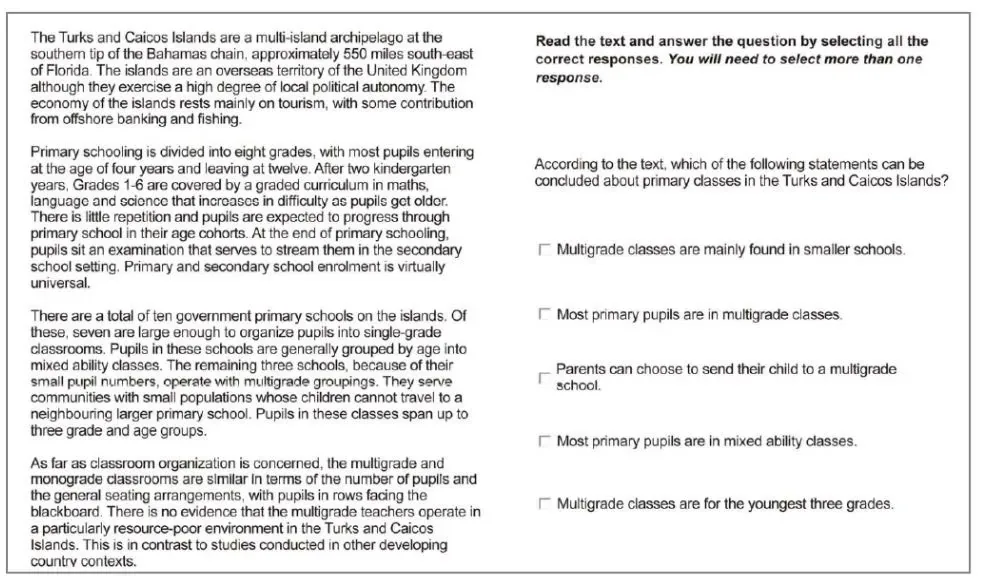
    Reading passage about Turks and Caicos Islands schooling with five MCQ checkbox options on the right.
    Note any repeated words in the options

    Quickly read through the response options and note any words that are repeated, particularly adjectives (e.g. 'multigrade') or nouns (e.g. 'classes'). If the same noun phrase occurs in a lot of the options, the answer is probably related to this phrase.

    Scan the text for the repeated words. Then read around them to find the answer more quickly:
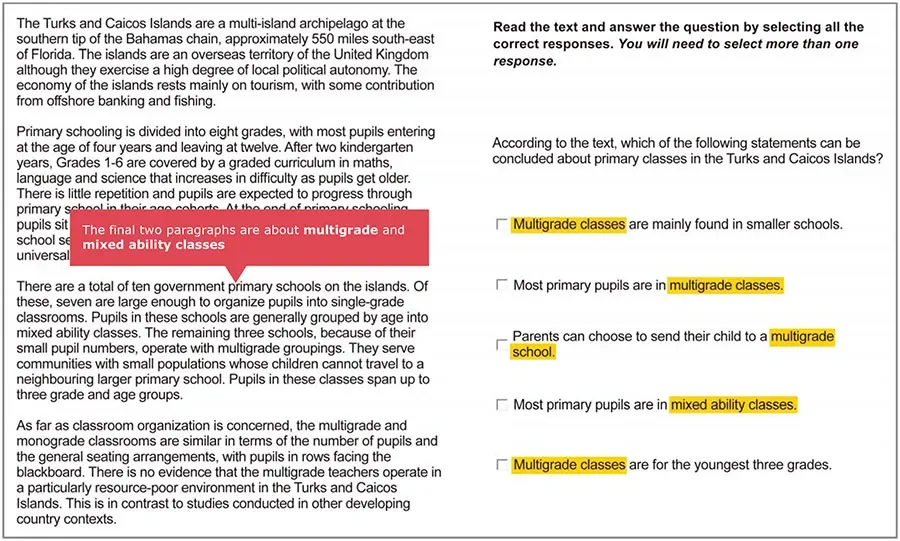
    Same passage with the final two paragraphs highlighted, showing repeated words 'multigrade classes' and 'mixed ability classes' across the answer options.
    How this question is scored

    Your response is judged on your ability to use contextual and grammatical cues to select the correct answers. You score 1 point for each correct option selected and lose 1 point for each incorrect option selected. The minimum score is 0. This question type contributes to your Reading score only — Listening, Speaking and Writing are not affected.

    Multiple Choice Multiple Answers (Reading) deducts a point for every wrong option you tick. The minimum trait score is 0 — you can’t go negative — but reckless ticking costs points you already earned.

    What raises your score
    • Only tick options you can defend with a line in the text.
    • If you’re 50/50, leave it — guessing is net negative.
    What lowers it
    • Selecting all options ‘to be safe’ — guarantees the minimum score.
    Click a band to exploreMax varies
    +1
    • Each correct response.
    • ◾+1 for each correct option ticked.
    • ◾−1 for each incorrect option ticked (negative marking).
    • ◾Minimum item score is 0 — wrong picks can never push you below zero.
    • ◾Contributes to Reading only.
    • ◾Only tick options you can defend with a line in the text — guessing is net negative.

    Keep going with Reading MCQ