
Reading MCQ — Single Answer
Reading MCQ Single Answer tests your ability to read carefully and pick the ONE correct option from a list. There is no negative marking — always answer. On this page: an overview, the exam interface, top strategies (Before / During the test), common mistakes, points to remember and a full simulator with the most-repeated 2026 questions.
Overview
Length of text:
up to 300 words
Correct answers:
exactly one
Options shown:
4–5
Number of these tasks:
2–3
Total time for reading tasks:
29–30 minutes
Read a short academic text and answer a multiple-choice question with ONE correct response. Click the option you think is correct — selected option highlights yellow. Click another to switch your answer.
- There is exactly ONE correct answer — the prompt says 'select only one'.
- No negative marking — wrong answers cost 0, but missed questions also cost 0. ALWAYS pick something.
- The reading-section timer counts down for ALL reading tasks — manage your pace (1.5–2 min per item).
- Don't read the passage first — read the question, then read with purpose.
How Reading MCQ — Single Answer contributes to your score
Task
Reading MCQ — Single Answer
scoring
Reading
Overall
Your voice → analysed by AI → contributes 2.5% to Reading and 0.55% to Overall.
Watch — How To Answer Reading MCQ (Single Answer)
Official PTE School walkthrough — how to answer Reading MCQ with one correct answer.
How the test screen works
The screen below is annotated with green markers (1–5). Hover each one — they cover the reading-section timer, the prompt, the passage, the option radio buttons (click one to pick, click another to switch) and the Next button. Pick the option you think is correct, then press Next.
Reading MCQ — Single Answer — Exam Interface
Annotated walkthrough of the actual Pearson screen. Click any option to select it (yellow highlight). Hover the green markers to see what each part of the screen does. Press Show Answer when you're ready to check.
Read the text and answer the multiple-choice question by selecting the correct response. Only one response is correct.2Read the prompt. The phrase 'select only one' tells you this is single-answer — NO negative marking, so always pick something.
According to the text, which of the following best describes the writer's main point about Hymenoptera?
Hover the green markers to see what each part of the screen does.
What this task tests
Skill assessed
Reading
Score weight
up to3points
The AI scorer checks
Criterion
Identifying the topic, theme or main ideas of a text.
Criterion
Identifying supporting points and examples.
Criterion
Drawing inferences from a text.
Tone
Analyzing the writer's purpose, style, tone or attitude.
Top Strategies for Success in Reading MCQ (Single Answer)
Read the question first — and know what it's asking
Reading MCQ Single Answer questions test comprehension: identifying main ideas, details, the writer's purpose, attitude or opinion. Reading the question before the text tells you exactly what to look for — so you don't waste time on the wrong details.
The 6 question types — and what each one is really asking
Reading the question is half the work. Spot the pattern first — the words on the left tell you which reading skill on the right you need to use.
Before test day, take any short academic paragraph and write your own question for each of the 6 types above. You'll start spotting the pattern in seconds.
Skimming vs Scanning
Two different ways of reading — both rewarded in MCQ Multiple Answers.
Skimming
Aim — find the main ideas
- Short texts: read the first & last sentence of each paragraph.
- Longer texts: skim the introduction & conclusion.
- ~30 seconds — get the gist, no full reading.
Scanning
Aim — find specific details
- Hunt for names, numbers, dates, key words.
- Don't read every word — let your eye jump to matches.
- Perfect for matching options to evidence in the text.
Practice Tips
Build the habit- 1
Practise on short academic texts (one to two paragraphs) from books or magazines. Identify the writer's main point and purpose (to inform, argue, warn, criticise, describe, persuade, explain, etc.).
- 2
Locate topic sentences — usually (but not always) the first sentence of a paragraph. They give you the paragraph's main idea.
- 3
Identify cohesive devices. Highlight a word like this or it and find what it refers back to. Or find a repeated idea/synonym chain through a paragraph.
- 4
Practise within a 1.5–2 minute time limit per task. Single Answer is faster than Multiple Answers.
Quick tips — Do this, not that
- Tip 01
You read the question first to know what to look for.
You don't read the text before knowing the question.
- Tip 02
You select the option you can best justify from the text.
You don't pick an option just because its words appear in the text.
- Tip 03
You always pick something — there is no negative marking.
You don't leave the question without an answer.
- Tip 04
You keep an eye on the timer to leave room for the rest of the reading section.
You don't spend more than 1.5–2 minutes on a single MCQ task.
Practice now with your trainer
Practice — Railway expansion in 19th-century Europe
Practise here without help. Read the prompt, skim the passage, then pick the ONE option you can justify. Use the reflection checklist below and check the answer key — don't peek before you've tried!
Practice question — Reading MCQ Single Answer
Same Pearson-style screen as the real test. Pick the correct option, then check your answer.
Read the text and answer the multiple-choice question by selecting the correct response. Only one response is correct.
What does the writer suggest was the main consequence of railway expansion in nineteenth-century Europe?
Reflecting on your practice
Private to you — tick each item you actually did. Saved on this device only.
Check the answerClick to revealHide
Check the answerClick to revealHide
Were you correct? Try to think about how you could improve.
Answer: C — Communities began to share a single, standardised sense of time.
Why the others fail: A) The text doesn't say towns refused; B) the text says railway companies pushed for it, not just governments; D) timetables became fixed, not flexible.
Want a trainer to mark your reading practice?
Send a screenshot of your selection on WhatsApp and our trainers will explain the evidence behind the correct option — and why each wrong option doesn't fit.
💬 Get evaluated on WhatsApp
Common Mistakes in Reading MCQ — Single Answer
Watch the most frequent mistakes test takers make in Reading MCQ Single Answer — and how to avoid each one.
Points To Remember
Reading Tasks- 1
No negative marking
1 point for the correct answer, 0 for a wrong answer or no answer. Always pick something — leaving it blank is the same as guessing wrong.
- 2
15–20 reading tasks total
The Reading section has 15–20 tasks with ONE shared timer. Spend no more than 1.5–2 minutes here.
- 3
Skim then scan
Skim the passage once for the main idea, then scan back for the specific detail the prompt asks about.
- 4
One click = one answer
Click an option to pick it. Click a different option to switch — only your final selection counts.
Quick Tips for a Better Score
Note the key words in the prompt before you read the text
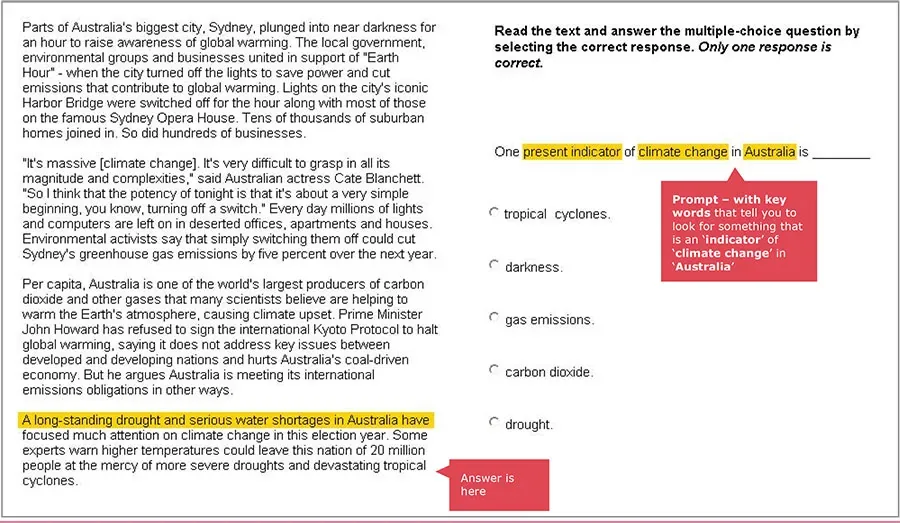
The prompt for this item type may be a question or a sentence that you have to complete. Whatever type of prompt you get, read it carefully because it will tell you what information you need to find in the text.
If you focus on the key words in the prompt, you will find the answer more quickly and spend less time reading the text.
Evaluate the response options
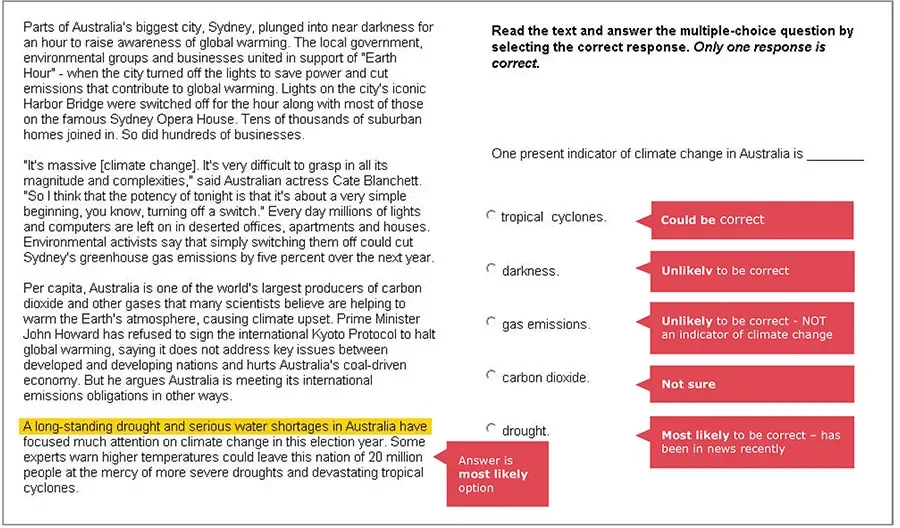
The response options may be words, phrases or sentences. Use your own knowledge to decide whether any of them are unlikely to be correct, or likely to be correct. You can do this before you read the text.
If you read the text but cannot answer the question, choose the option that you think is most likely to be correct. This strategy also applies to multiple-choice questions with more than one answer.
How this question is scored
Your response is judged on your ability to use contextual and grammatical cues to select the correct answer. You score 1 point if your answer is correct, 0 if it is incorrect. There is no negative marking. This question type contributes to your Reading score only — Listening, Speaking and Writing are not affected.
RW-Fill in the Blanks, R-Fill in the Blanks (drag & drop) and Reorder Paragraph all use partial credit. There is no penalty for wrong answers — but for Reorder, only correctly adjacent pairs count, so one misplaced paragraph can cost two pairs.
- Always fill every blank — no penalty for guessing.
- For Reorder, find the topic sentence first (no pronouns, introduces the subject).
- Use grammar clues for blanks: article → noun, ‘to’ → infinitive.
- Leaving blanks empty when unsure.
- Picking words by meaning alone, ignoring grammar/collocation.
- Each correctly completed blank / each correct adjacent pair.
Coach tip · Reorder: chain by referring expressions (this, these, such, the latter).
- ◾Maximum score = 1 point per question.
- ◾Wrong answer = 0 points. Blank = 0 points. ALWAYS pick something — guessing costs nothing.
- ◾Only your final selected option counts — switching is free.