PTE Made Easy·RLspeaking Reading time: 14 minutes 2–3 items
    Made Easy

    Retell Lecture

    Retell Lecture (RL) is a Speaking task where you listen to a short academic lecture and retell it in your own words using clear language, accurate pronunciation and natural intonation. On this page: an overview of the task, top strategies for note-taking and the 40-second response, sample answers and common mistakes to practise with your trainer, the most repeated 2026 lectures, and a guided task worksheet.

    Chapter

    Overview

    • Lecture length:

      60–90 seconds

    • Time to record your response:

      40 seconds

    • Number of these tasks:

      2–3

    Retell Lecture tests your ability to retell — through speaking — the main points of a short academic lecture you have just heard or watched, using your knowledge of grammar, vocabulary and intonation.

    • You will see instructions and (sometimes) an image or short video.
    • After a 3-second countdown the lecture plays automatically. You only hear it once.
    • You then have 10 seconds to prepare, followed by 40 seconds to retell the lecture in your own words.
    • This task tests your speaking skills (Content, Pronunciation, Oral Fluency) and your listening skills.
    Scored by AI + Human expert review

    How Retell Lecture contributes to your score

    AI
    scoring
    Human
    review
    0%

    Speaking

    0%

    Listening

    0%

    Overall

    Your voice → analysed by AI + human expert → contributes 13% to Speaking, 13% to Listening and 6% to Overall.

    Watch — Retell Lecture walkthrough

    Official PTE School walkthrough — how to answer Retell Lecture.

    How the test screen works

    The screen below is annotated with green markers (1–5) placed right next to the element they describe. Each marker is explained on hover — they cover the timer, instructions, lecture video, recording status box and the Next button.

    SimulatorReady
    PPTE Academic - Candidate Name
    Time Remaining 00:21:42 14 of 33
    1Timer for the whole part of the test.
    3The lecture audio plays automatically — you only hear it once.

    You will hear a lecture. After listening, in 10 seconds, retell what you have just heard in your own words. You will have 40 seconds to give your response.2Read the task instructions carefully.

    Lecture audio

    Plays automatically when you start

    Audio Recorder

    Recording in 10

    0:00 / 0:10
    4After the lecture, 10 seconds to prepare, then 40 seconds to record.
    5Click 'Next' to move on once the status shows 'Completed'.
    Retell Lecture — Exam InterfaceAnnotated walkthrough of the actual Pearson screen. Press Start: 10s prep → video plays → beep → 40s to retell. Hover the green markers for what each part does.

    What this task tests

    Skills assessed · 2 strands

    Speaking + Listening

    Combined score weight

    up to2713 + 14 points

    This task feeds two separate score strands. The AI evaluates different things for each — see the breakdown below.

    Strand

    Speaking

    up to13points

    The AI scorer checks

    Fluency

    Speaking fluently at a natural speed for the full 40 seconds

    Pronunciation

    Using clear pronunciation, stress and rhythm

    Vocabulary

    Using a wide range of academic vocabulary in your own words

    Criterion

    Organising the retell logically: introductory sentence → main points → relationships → implication / conclusion

    Strand

    Listening

    up to14points

    The AI scorer checks

    Comprehension

    Understanding the overall meaning and purpose of the lecture

    Criterion

    Identifying main points, examples and supporting details

    Comprehension

    Understanding the relationships between ideas (cause/effect, contrast, conclusion)

    Intonation

    Understanding meaning conveyed through the speaker's intonation and stress

    Chapter

    Top Strategies for Success in Retell Lecture

    Strategies for success · Before the test
    1

    Starts with an introductory sentence, giving the main point

    2

    Includes plenty of information from the recording

    3

    Retells implications or conclusions from the recording

    4

    Clearly shows how the ideas are related to each other

    7

    Uses accurate pronunciation, including intonation, rhythm and stress

    A good summary

    It's important to know what a good summary looks like.

    5

    Is clearly and logically structured

    6

    Uses mostly your own words, rather than whole phrases or sentences from the lecture (use a phrase or two from the lecture if you have to, rather than miss out a point)

    When getting ready for this task type, focus on these three habits.

    Train your ear with academic listening

    Watch online lectures, TED talks, university podcasts on a wide range of topics. Listen to 60–90 second chunks and retell them aloud in your own words. Cover topics outside your comfort zone — exam lectures can be on anything from biology to economics.


    Build an academic note-taking system

    Develop your own abbreviations and symbols so you can capture key words quickly. Practise writing only the main points and signal words (however, in conclusion, the issue is…) — never full sentences.

    Build academic vocabulary

    Learn topic vocabulary, synonyms and collocations. Being able to paraphrase what you heard (instead of repeating it) is the single biggest content-score booster. Practise restating a sentence in 2–3 different ways.

    Practice Tips

    Follow To Succeed
    1. 1

      Find online videos (formal talks, discussions or university lectures) or academic podcasts on general topics. Choose ones that give information, but avoid news websites as these are different from what you will hear in the test. Listen to 50–90 seconds of a video and:

      • Identify the main points of the talk, any examples or evidence, and any opposing arguments.
      • Listen for signal words that indicate the main points (e.g. We need to focus on…, The issue here is…, What we've discovered is…, For instance, To illustrate, On the contrary).
      • Make sure you understand these expressions — they help you identify key information and structure your summary logically.
    2. 2

      Create your own techniques for quick note-taking. Choose your own abbreviations and symbols and practise using them so they become automatic. Practise writing the key words of main ideas and important details.

    3. 3

      Practise in an environment with other people talking around you — for example, with the TV and/or radio on. There are likely to be people talking at the same time as you in the test room.

    Quick tips — Do this, not that

    • Tip 01

      You start with an introductory sentence giving the main point.

      You don't dive straight into details without setting the topic.

    • Tip 02

      You retell the ideas in your own words.

      You don't repeat whole phrases or sentences from the lecture.

    • Tip 03

      You include the relationships between ideas (cause, contrast, conclusion).

      You don't list bullets of facts with no link between them.

    • Tip 04

      You speak for the full 40 seconds.

      You don't stop after 15–20 seconds, even if you've run out of notes.

    • Tip 05

      You use academic vocabulary and signal words.

      You don't pad with fillers like "um, um, the lecture is about…".

    • Tip 06

      You speak normally — natural pace, normal volume.

      You don't rush, mumble or shout into the mic.

    Chapter

    Practice now with your trainer

    Try Retell Lecture 2 — Practice with Trainer

    This practice item is image + audio (a topic-stimulus image plays alongside the lecture audio). Press Start to run real exam timing — the audio plays, then 10s prep, then 40s to retell. Compare your version with the model below.

    SimulatorReady
    PPTE Academic - Candidate Name
    Time Remaining 00:21:42 Practice
    Retell Lecture stimulus

    You will hear a lecture. After listening, in 10 seconds, retell what you have just heard in your own words. You will have 40 seconds to give your response.

    Lecture audio

    Plays automatically when you start

    Audio Recorder

    Recording in 10

    0:00 / 0:10
    Practice question — Retell Lecture 2 (Savings in India)Same Pearson-style screen as the real test. Take notes, then retell in your own words.

    Model recording

    Retell Lecture 2 — Sample Answer

    Listen to a strong sample answer. Notice the introductory sentence, the use of own words and the clear closing point.

    Show transcript

    The enormous rise of the middle class in certain developing countries is one of the greatest economic successes of the late 20th and early 21st centuries. This is excellent for the economies of those countries because the middle classes usually earn more than they need to live on, and thus they can save money. It's important that economists understand how these processes work, and thus they need to understand the savings habits of the new middle class. Our research, therefore, aimed to investigate patterns of savings and reasons for savings decisions. The country we chose to focus on was India. We found that, not surprisingly, it was the richer people, especially business owners, who tended to save more. As for the reasons for saving, the number one reason was to provide an income after retirement. Having an income after becoming too old to work was important for savers who wanted to be able to enjoy their older years. And the second most important reason was for family purposes, such as the education and weddings of their children.

    Want a coach to score your attempt? Send your recording on WhatsApp and we'll reply with personalised feedback.

    Send on WhatsApp
    Chapter

    Sample answers with feedback

    Listen to the lecture again

    Replay the original Retell Lecture 1 video before reviewing the sample answers below. Compare each speaker's retell against what you actually heard.

    SimulatorReady
    PPTE Academic - Candidate Name
    Time Remaining 00:21:42 Replay

    You will hear a lecture. After listening, in 10 seconds, retell what you have just heard in your own words. You will have 40 seconds to give your response.

    Lecture audio

    Plays automatically when you start

    Audio Recorder

    Recording in 10

    0:00 / 0:10
    Retell Lecture 1 — Lecture replayPress Start to hear the lecture again under exam conditions.

    Retell Lecture 1 — English Speaker's Response

    An English-speaker's reference answer for Retell Lecture 1 (Health & Food). Click to play the audio, then reveal the transcript to compare.

    English Speaker — Retell Lecture 1 Sample AnswerC1
    +
    ▶Sample Answer Transcript

    The speaker said that some health messages about food are confusing. For example, there are debates about whether fat or sugar is bad for you when in fact both are problematic. She said that dietary guidance to the public should shift away from a focus on individual nutrients such as protein and carbohydrate, towards guidelines relating to actual food, for example meat, vegetables or biscuits. Moreover, the issue isn't about deciding which foods to eat or to abstain from. Instead, it's about eating patterns as a whole, and the proportions of the different foods in relation to each other.

    Sample Answers & Feedback by Level

    Compare responses at C1, B2 and B1 levels. Click any card to listen, reveal the transcript and read examiner feedback.

    Sample Answer 1 — C1C1
    +
    ▶Sample Answer Transcript

    The speaker said that we should not differentiate between different nutrients, such as protein, carbohydrates and fat, but rather between different foods, such as meat, fish and vegetables, in order to avoid public confusion regarding messages about healthy eating and achieve an understanding of our diet patterns as a whole.

    Feedback

    • ◾A confident, well-organised response. The retell is paraphrased in the test taker's own words, captures the main idea and the contrast (nutrients vs foods), and finishes with the implication. Pronunciation, stress and intonation are clear and natural.
    Sample Answer 2 — B2B2
    +
    ▶Sample Answer Transcript

    According to the speaker, there is public confusion about some messages about food, for example the debate about fat against sugar. Really, both are bad. While science looks at individual nutrients, the message to the public should be about food — meat, vegetables, etc. The important thing is to understand patterns of diets, and how much of each food group to eat.

    Feedback

    • ◾The response re-tells the lecture accurately and gives enough detail to understand what the lecture was about. There are, however, some minor grammar and vocabulary mistakes, which do not affect our understanding. The test taker's speech has acceptable speed, but is slightly uneven because he hesitates twice. Overall, the test taker's pronunciation is good as only a few words are mispronounced. But this also does not affect the overall response negatively. The response is thirty-two seconds long.
    Sample Answer 3 — B1B1
    +
    ▶Sample Answer Transcript

    The lecture is about foods. There is a debate about fat and sugar and what we should eat. We should talk more about foods — meat, fish, vegetables and so on. Some people say some foods are allowed and other foods are not allowed.

    Feedback

    • ◾The response captures only the surface idea. The retell is short, lacks the main implication (about patterns of diets and proportions), and uses simple vocabulary. There are noticeable hesitations and a few mispronunciations. To move up, the test taker needs more academic vocabulary, a clear introductory sentence and a closing point.

    Reflecting on your practice

    Private to you — tick each item you actually did. Saved on this device only.

    0/9

    Common Mistakes in Retell Lecture

    These pitfalls apply to most retell tasks — watch the video and read the fix.

    Don'tSpeaker without proper headset positionToo close

    Mic too close or off-position · voice distorts

    DoSpeaker with headset mic at correct distance~3 cm

    Headset on · mic ~3 cm from the side of mouth

    01

    Trying to write down the whole lecture

    Problem · Many students try to capture every word in their notes. They miss the main idea and panic when the audio stops because their notes are messy and unusable.

    Fix · Only capture key words and signal words. Write the main idea first, then 2–3 supporting points and the conclusion. Practise this structure until it's automatic.

    Don't
    Audio RecorderRecording…
    0:000:40
    Next

    Clicking Next while recording → answer cut off

    Do
    Audio RecorderCompleted
    0:000:40
    Next

    Wait for ‘Completed’, then click Next

    02

    Stopping after 15–20 seconds

    Problem · If you finish your retell in 20 seconds, the engine reads it as incomplete content and your Content score drops sharply.

    Fix · Plan your retell to fill the full 40 seconds. Add an example, restate a relationship, or finish with an implication. Never click Next early.

    Watch — Common Mistakes in Retell Lecture

    Tap play to watch — common pitfalls students make and how to avoid them.

    Chapter

    Most Repeated Retell Lectures in 2026

    Most Repeated Retell Lectures in 2026

    Listen to four of the most repeated Retell Lecture audios in 2026. Each card uses the real exam interface — instructions, lecture audio and the Next button. Take notes and practise retelling each one in 40 seconds.

    1. 1
      PPTE Academic
      Item 1 of 4 · 00:27:59

      You will hear a lecture. After listening to the lecture, in 10 seconds, please speak into the microphone and retell what you have just heard from the lecture in your own words. You will have 40 seconds to give your response. — Topic: Sugar

      📄 TranscriptShow

      There's sugar in a lot of foods where you don't expect it. And of course, you know, there's lots of sugar in donuts or ice cream or pastries or other things that are sweet, candy of course. But there are other places where you see it and you don't necessarily expect it. So as an example, peanut butter. Here's a list of ingredients from Skippy peanut butter and you see that sugar is the second most common ingredient. Excuse me. You may know from reading food labels that these ingredients in any food label are listed in order of how much there is in the food itself. So sugar comes right after peanuts. Here's another example, beef stew. You wouldn't necessarily expect to find sugar in beef stew, but it's there. Now, it's down the list of ingredients. It's actually toward the end. But if you look at the marketing of this and look at the can, it says, There's fresh potatoes and carrots, but actually there's more sugar in this than there is carrots. And so you wouldn't eat something like beef stew and expect to find this to be the case.

    2. 2
      PPTE Academic
      Item 2 of 4 · 00:27:59

      You will hear a lecture. After listening to the lecture, in 10 seconds, please speak into the microphone and retell what you have just heard from the lecture in your own words. You will have 40 seconds to give your response. — Topic: Psychologist Sigmund Freud

      📄 TranscriptShow

      Now, for better or worse, we live in a world profoundly affected by Sigmund Freud. If I had to ask you, "Choose a psych— name a famous psychologist," the answer— most of you would be Freud. He's the most famous psychologist ever and he's had a profound influence on the 20th and 21st century. Some biographical information. He was born in the 1850s. He spent most of his life in Vienna, Austria and— but he died in London. And he escaped to London soon after retreating there at the beginning of World War II as the Nazis began to occupy where he lived. He's one of the most famous scholars ever but he's not known for any single discovery. Instead, he's known for the development of an encompassing theory of mind One that he developed over the span of many decades.

    3. 3
      PPTE Academic
      Item 3 of 4 · 00:27:59

      You will hear a lecture. After listening to the lecture, in 10 seconds, please speak into the microphone and retell what you have just heard from the lecture in your own words. You will have 40 seconds to give your response. — Topic: Performance of Boys and Girls

      📄 TranscriptShow

      You can see that the two charts each give quite a different picture of the performance of boys and girls in the two key subjects of maths and English. It shows that in English, girls consistently outperform boys over a period of 6 years, achieving scores about, uh, 10% above their male peers. There is quite a different picture when we look at the maths results, with no real difference between genders in the results. What is the explanation for these key differences? To answer this question, researchers look at biological and cognitive factors and a range of social factors. The interaction between these different components in early childhood development are seen as maintained and reinforced in the school context, and this leads to distinct gender patterns of behavior in skills with direct consequences for school performance and achievement. The argument uses this evidence to show that biological factors, such as patterns of cognitive development, are closely linked to social factors, such as learned gender categories. These cognitive skills are learned both preschool and subsequently at school, supported by the responses of teachers creating a reinforcement of patterns.

    4. 4
      PPTE Academic
      Item 4 of 4 · 00:27:59

      You will hear a lecture. After listening to the lecture, in 10 seconds, please speak into the microphone and retell what you have just heard from the lecture in your own words. You will have 40 seconds to give your response. — Topic: Measuring Food

      📄 TranscriptShow

      I'm a dietitian and I work in clinical weight loss research. Accurately estimating portion size is critical in research or real-world settings. For example, if you're trying to watch your weight and you're out to dinner and you're presented with a bowl of food, there's no really good way to actually estimate how much you're eating unless you're going to whip some scales out of your bag. So we wanted to find a more objective way for people to quantify what they're eating when they're out and about. I came up with a more hands-on approach. We got people to measure the dimensions of the food using the width of their fingers, and remembering back to primary school maths, we used the geometric volume formulas to estimate the weight of the food. To show you how this works, I've ordered a piece of lasagne, and that's my box, a glass of wine, and that's my cylinder, and I'm feeling pretty healthy, so I ordered some watermelon for dessert, and that's my wedge. So this lasagne is 7 by 5 by 4 fingers. In the future, I see this method being incorporated into smartphone applications. So you put your finger widths in along with your height and your weight, and the app will do all of the calculations for you, and then you've got a more accurate way to estimate the portion size.

    Quick Tips for a Better Score

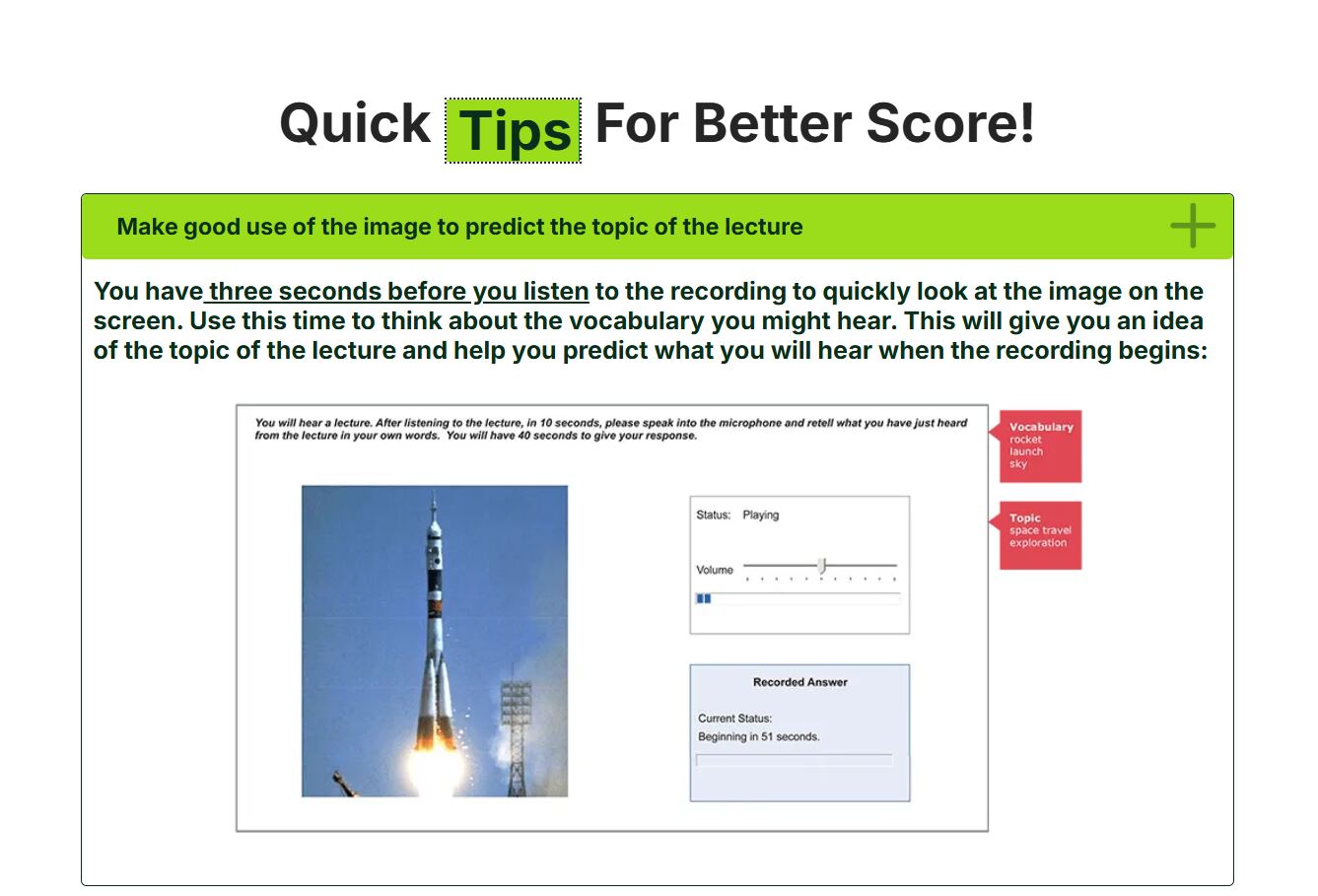
    Make good use of the image to predict the topic of the lecture

    You have three seconds before you listen to the recording to quickly look at the image on the screen. Use this time to think about the vocabulary you might hear. This will give you an idea of the topic of the lecture and help you predict what you will hear when the recording begins.

    Exam screen showing a rocket launch image with vocabulary and topic prediction labels
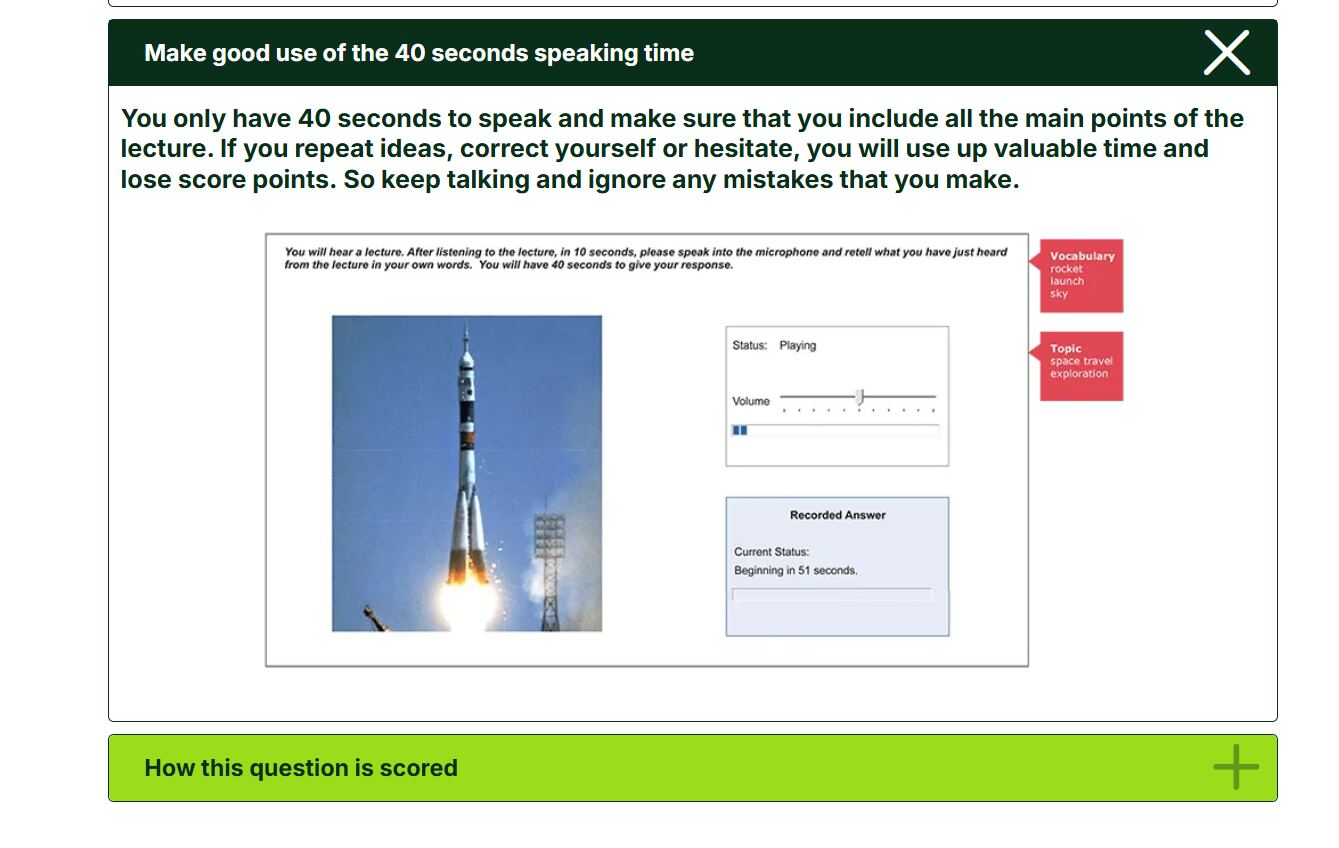
    Make good use of the 40 seconds speaking time

    You only have 40 seconds to speak and make sure that you include all the main points of the lecture. If you repeat ideas, correct yourself or hesitate, you will use up valuable time and lose score points. So keep talking and ignore any mistakes that you make.

    Exam screen showing the 40 seconds speaking time and recorded answer panel
    How this question is scored

    Your Retell Lecture score combines Listening + Speaking traits. Open the cards below to see what raises and lowers your score, with full band descriptors.

    Content for speaking tasks is rated on whether you say the right things — the words from the prompt (Read Aloud, Repeat Sentence) or the right ideas with detail (Describe Image, Retell Lecture, Respond to a Situation). For Describe Image / Retell Lecture / SGD / RTAS, a human also reviews Content.

    What raises your score
    • Use a template only as a frame — fill it with the actual data/ideas.
    • For Describe Image: state type → main trend → 2 specific data points → comparison → conclusion.
    • For Retell Lecture: topic → 3–4 key points → speaker’s conclusion.
    • Paraphrase — don’t repeat the prompt word-for-word.
    What lowers it
    • Memorised template with no real content from the image / lecture.
    • Listing labels (“There is bar one, bar two, bar three…”) without describing.
    • Stopping after 15s when 30–40s is allowed.
    Click a band to exploreMax 5
    5Full, accurate, nuanced
    • Covers all key features/ideas with accurate detail and clear relationships; uses varied vocabulary.

    Coach tip · If you can’t see a number on the chart, describe the trend instead — never invent data.

    • ◾Partial credit applies. No credit is given for no response or an irrelevant response.
    • ◾This question type affects your Listening, Speaking, Oral Fluency and Pronunciation scores.
    Chapter

    Retell Lecture — Official 7-step worksheet

    1

    1. Familiarise yourself with the task & equipment (True / False)

    Step 1 of 12

    +

    Tick the statements you believe are TRUE about how the Retell Lecture task works on screen.

    2

    2. Note-taking — compare the two sets of notes

    Step 2 of 12

    +

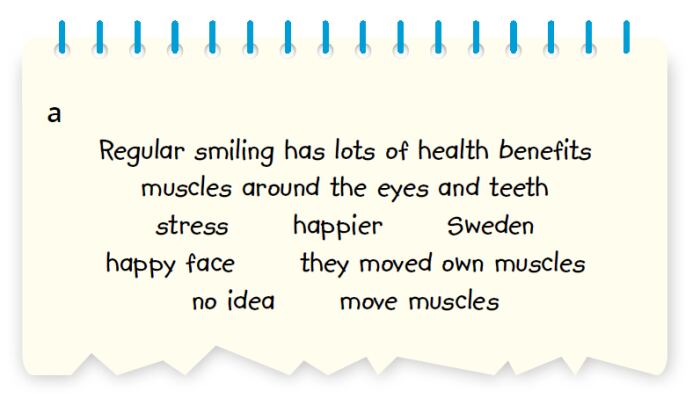
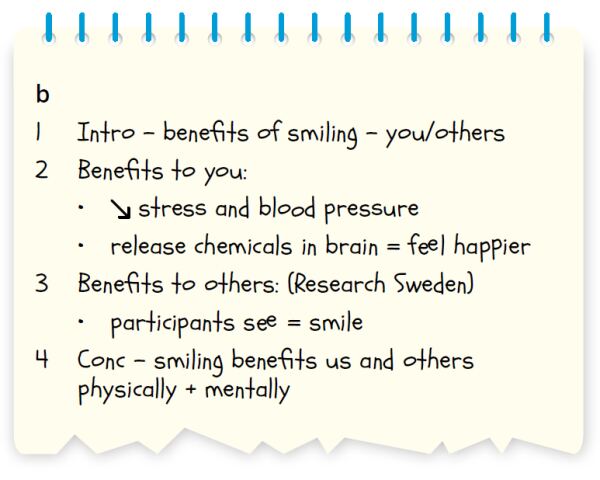
    Note-taking is very important because you probably won't remember everything you hear. Look at the two sets of notes below. Which one is a good example of note-taking? Why? What is wrong with the other set?

    Set a
    Set a
    Set b
    Set b

    1. Which set (a or b) is the good example, and why?

    2. What is wrong with the other set?

    3

    3. When does each action happen?

    Step 3 of 12

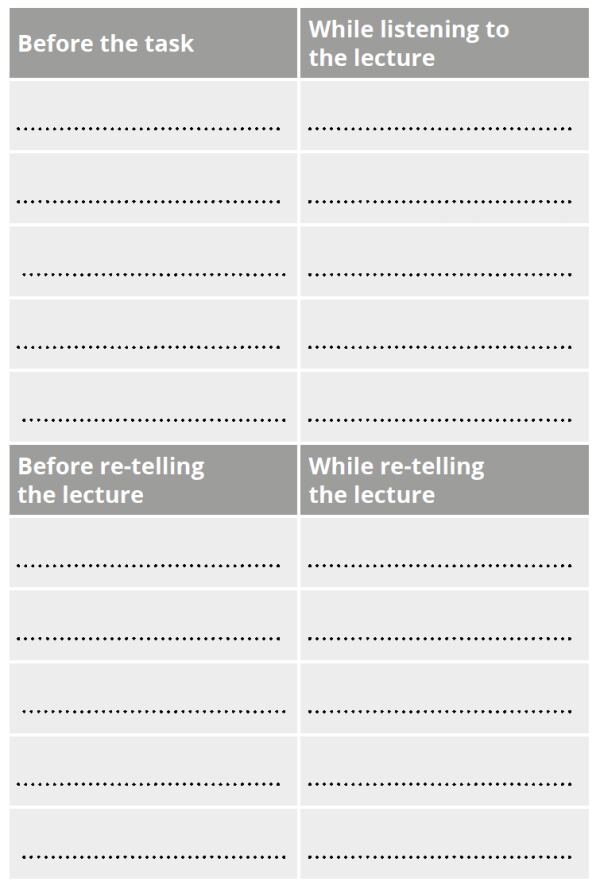
    +

    Read actions 1–16 and decide where each one belongs: Before the task / While listening to the lecture / Before re-telling the lecture / While re-telling the lecture. Tick each action once you've placed it.

    Place each action below into one of these four columns.
    Place each action below into one of these four columns.
    4

    4. Put the parts of your response in the correct order

    Step 4 of 12

    +

    Number a–d from 1 (first) to 4 (last) so that your retell has a clear structure.

    1. a. The first main point — order:

    2. b. An introductory sentence — order:

    3. c. A conclusion — order:

    4. d. The second main point — order:

    5

    5.1 Listen to the lecture & choose the correct linking words

    Step 5 of 12

    +

    5.1. Listen to a lecture and read the transcript of its re-telling. Choose the correct linking words and phrases.

    🎧 Model audio

    Transcript (click to show)Show

    The speaker was talking about the impact of women's participation on a country's development. ¹ Even though / Even so, women's participation could be greater, progress has been made everywhere. ² It is clear that / Fortunately, women being independent and having skills leads to better resources and conditions and more opportunities for girls to access education. ³ The conclusion is that / Finally, this will have great implications for the women of the future.

    1. ¹ Even though / Even so:

    2. ² It is clear that / Fortunately:

    3. ³ The conclusion is that / Finally:

    6

    5.2 Match a–d (Exercise 4) with the correct sentence in 5.1

    Step 6 of 12

    +

    Look again at the parts of a response in Exercise 4. Match a–d in Exercise 4 with the correct sentence in the transcript in Exercise 5.1.

    1. a. The first main point — sentence from 5.1:

    2. b. An introductory sentence — sentence from 5.1:

    3. c. A conclusion — sentence from 5.1:

    4. d. The second main point — sentence from 5.1:

    7

    6. Scoring traits — write C (content), F (fluency) or P (pronunciation)

    Step 7 of 12

    +

    In the Retell Lecture task you are scored on Content, Fluency and Pronunciation. For each trait, write C, F or P next to it.

    1. 1. Rhythm —

    2. 2. Description of developments —

    3. 3. Use of standard English sounds —

    4. 4. Hesitation —

    5. 5. Pace of speech —

    6. 6. Ease of understanding each word —

    7. 7. Appropriate words and phrases —

    8

    7.1 Look at the photo — what do you think the lecture will be about?

    Step 8 of 12

    +

    Before you listen, look at the image and predict the topic and the vocabulary you might hear.

    Stimulus image for the Retell Lecture
    Stimulus image for the Retell Lecture

    1. Predicted topic of the lecture:

    2. Vocabulary you expect to hear:

    9

    7.2 Practise describing the image — focus on intonation

    Step 9 of 12

    +

    Listen to the lecture, then record yourself describing the image. Check that your intonation sounds natural. Remember: you only have 40 seconds.

    🎧 Model audio

    1. Your notes (key words only):

    2. Self-check — was your intonation natural? What would you change?

    10

    7.3 Listen to a test-taker's retell — review their performance

    Step 10 of 12

    +

    Listen to this learner's retell, then answer the questions below.

    🎧 Model audio

    1. 1. What main points did the test taker cover?

    2. 2. Did the test taker miss any major points?

    3. 3. Did the test taker cover everything you noted when you listened to the lecture?

    4. 4. Did the test taker repeat any information?

    5. 5. Were there any hesitations or false starts? What effect did these have?

    6. 6. Did the test taker make any grammar or vocabulary mistakes?

    7. 7. How could the re-telling be improved?

    11

    7.4 Read the transcript & check your answers

    Step 11 of 12

    +

    Reveal the transcript of the test-taker's response and check your answers from 7.3.

    Test-taker transcript (click to show)Show

    In this picture, it is a rocket, and it is, it is a rocket which can head for the space station which is built by Russian 30 years ago. And what is, what is drawing our attention is the backfield. Half a century ago, the Russian has have the technology to support the rocket.

    1. Updated answers / corrections after reading the transcript:

    12

    7.5 Now you do the Retell Lecture

    Step 12 of 12

    +

    Use your notes from 7.2. Time yourself — you have only 40 seconds. After recording, tick the statements that are true for you.

    Keep going with Retell Lecture

    Useful Language for Speaking

    Open the Speaking Useful-Language toolkit

    A trainer-ready resource covering academic style, collocations, signposting, cause/effect, comparison, image description, hypothesis and estimation — every exercise has a hidden suggested answer. Use it for every speaking task.

    Open speaking resources