
PTE Made Easy·SSTlistening 10 minutes total · 50–70 word summary 1 item
    Made Easy

    Summarize Spoken Text

    Summarize Spoken Text (SST) is the first task of the Listening section, but it also contributes to your Writing score. You'll hear a 60–90 second academic lecture once, then write a 50–70 word summary in 10 minutes. On this page: an overview of the task, the exam interface, top strategies, sample answers and common mistakes — plus two real practice items with audio you can rehearse with right now.

    Chapter

    Overview

    • Lecture length:

      60–90 seconds

    • Total time for the task:

      10 minutes

    • Word range:

      50–70 words

    • Number of these tasks:

      1

    Summarize Spoken Text tests your ability to understand a short academic lecture and write an accurate, well-structured summary of its main ideas in 50–70 words.

    • You will hear a short lecture once — there is no replay. Take notes on your erasable noteboard while you listen.
    • After the lecture finishes, you have the remainder of the 10-minute window to plan, write and review your summary.
    • Use the on-screen Cut / Copy / Paste buttons to rearrange your summary. There is no spell-check.
    • This task contributes to both your Listening and Writing scores.
    Scored by AI + Human expert review

    How Summarize Spoken Text contributes to your score

    AI
    scoring
    Human
    review
    0%

    Listening

    0%

    Writing

    0%

    Overall

    Your voice → analysed by AI + human expert → contributes 18% to Listening, 18% to Writing and 4% to Overall.

    Watch — Summarize Spoken Text walkthrough

    Official PTE School walkthrough — how to answer Summarize Spoken Text.

    How the test screen works

    Press Start. A 5-second countdown plays, then the audio begins automatically. The 10-minute task timer only starts after the audio ends — if the lecture is 1 minute long, you'll have 9 minutes to type; if it's 2 minutes, you'll have 8. The screen below is annotated with green markers (1–5) — hover each one to see what it does.

    SimulatorReady
    PPTE Academic - Candidate Name
    Time Remaining 00:10:00 1 of 2
    1Timer counts down 10 minutes total for this Summarize Spoken Text task — listening + writing combined.

    You will hear a short report. Write a summary for a fellow student who was not present. You should write 50–70 words. You have 10 minutes to finish this task. Your response will be judged on the quality of your writing and on how well your response presents the key points presented in the lecture.2Read the instructions. After a short 5–7 second lead-in, the audio plays automatically — and only ONCE.

    Audio Status 3Status box shows ‘Beginning in X seconds’, then ‘Playing’, then ‘Completed’. The audio cannot be paused or replayed.

    Beginning in 5 seconds

    Plays once. Cannot be paused or replayed. 4Take notes by hand while listening — keywords, dates, the speaker's main argument. The bundle of notes is your scaffold.

    CopyCutPaste
    0 Words
    5Type a 50–70 word summary. Cut / Copy / Paste are available. Word counter goes red outside 50–70.
    6Click ‘Next’ when you are done — otherwise the test moves on automatically when the 10-minute timer runs out.

    Hover the green markers to see what each part of the screen does.

    Summarize Spoken Text — Exam InterfaceAnnotated walkthrough of the actual Pearson screen. Press Start: 5-second countdown → audio plays once → 10-minute writing window begins. Hover the green markers for explanations.
    SST 1

    What this task tests

    Skills assessed · 2 strands

    Listening + Writing

    Combined score weight

    up to2910 + 19 points

    This task feeds two separate score strands. The AI evaluates different things for each — see the breakdown below.

    Strand

    Listening

    up to10points

    The AI scorer checks

    Criterion

    Listening for the gist and the main ideas of an academic lecture.

    Criterion

    Identifying supporting points, examples and key details.

    Tone

    Understanding academic vocabulary and the speaker's tone.

    Criterion

    Holding ideas in working memory while taking concise notes.

    Comprehension

    Inferring meaning from context where words are unfamiliar.

    Strand

    Writing

    up to19points

    The AI scorer checks

    Criterion

    Writing under timed conditions with a strict 50–70 word limit.

    Criterion

    Communicating the main points clearly in your own words.

    Grammar

    Using accurate grammar, spelling and punctuation.

    Vocabulary

    Using a varied range of academic vocabulary.

    Intonation

    Producing well-structured complex sentences with appropriate linking.

    Chapter

    Top Strategies for Success in Summarize Spoken Text

    Strategies for success

    Before the test

    Note-taking

    Your summary relies on the quality of the notes you take while listening. Make sure you can take effective notes by:

    • focusing on the points — don't try to write down everything you hear,
    • using a wide range of abbreviations and symbols that you are familiar with to save time,
    • using columns and tables to show different speakers or opposing views,
    • using arrows to show the relationships between points,
    • using different writing sizes, underlining or circling to show headings or key information.

    Practice tips

    Practise note-taking

    • Take a short section of the lecture (around 30 seconds) — and take notes on the main idea. Write down key words, then stop and try writing a sentence that summarises what you heard.
    • Repeat with the next part of the lecture — and then the next, until you've built a 50–70 word summary.
    • Do a continuous 90-second run — without stopping. Then write your summary — you should not need more than ten minutes.
    • Review your practice summaries critically — Right amount of detail? All main points in a logical order? Grammar, vocabulary, punctuation and spelling clean?

    Practise simple, clear sentences

    • Short sentences score better than complex ones — with shaky grammar. Watch for word order, punctuation, spelling — your common mistakes.
    • Find lectures on topics you're interested in — Listen to short sections, identify the main points and supporting details.
    • Notice signposting language — phrases like "We need to focus on…", "The main issue is…", "For example…" mark the structure for you.

    A high-scoring SST summary follows these five rules. Internalise them now so they happen automatically on test day.

    Capture the main idea

    Identify the speaker's central argument first — it usually appears in the opening 15–20 seconds of the lecture.

    Add 2–3 supporting points

    Include the most important supporting details (causes, examples, results) — but skip minor anecdotes.

    Speaker's ideas only

    Never add your own opinion, evaluation or background knowledge. Stick to what the speaker actually said.

    Stay inside 50–70 words

    Outside this range scores 0 on Form (which also drags Content down). The sweet spot is 55–65 words.

    Paraphrase, don't copy

    Use synonyms and your own grammar. Direct quoting from memory rarely matches the lecture exactly and hurts your score.

    Quick tips — Do this, not that

    • Tip 01

      You take concise notes while listening — main idea + 2–3 supporting points.

      You don't try to transcribe everything word-for-word — you'll fall behind and miss the meaning.

    • Tip 02

      You write a 50–70 word summary that flows as proper sentences.

      You don't write bullet points or use ALL CAPS — both score 1 on Form.

    • Tip 03

      You stick to the speaker's ideas and paraphrase in your own words.

      You don't add your own opinions, examples or background knowledge.

    • Tip 04

      You watch the on-screen word counter.

      You don't drop below 50 or go above 70 — that scores 0 on Form (and 0 on Content).

    • Tip 05

      You use complex sentences with linking words.

      You don't write four short, disconnected sentences when one well-linked sentence would do.

    • Tip 06

      You leave 1–2 minutes to review grammar, spelling and word count.

      You don't submit without proofreading — small typos add up.

    Chapter

    Practice now with your trainer

    Try Summarize Spoken Text 2 — Practice with Trainer

    Practise with the strategies above. Real exam timing — 5-second countdown → audio plays once → 10-minute writing window begins. Take notes while listening, then write your 50–70 word summary.

    SimulatorReady
    PPTE Academic - Candidate Name
    Time Remaining 00:10:00 2 of 2

    You will hear a short report. Write a summary for a fellow student who was not present. You should write 50–70 words. You have 10 minutes to finish this task. Your response will be judged on the quality of your writing and on how well your response presents the key points presented in the lecture.

    Audio Status

    Beginning in 5 seconds

    Plays once. Cannot be paused or replayed.

    CopyCutPaste
    0 Words
    Practice question — Summarize Spoken Text 2Same Pearson-style screen as the real test. Listen, plan, write, review.
    SST 2

    Reflecting on your practice

    Private to you — tick each item you actually did. Saved on this device only.

    0/9

    Want us to evaluate your summary?

    Send your 50–70 word summary on WhatsApp and our trainers will mark it for content, form, grammar, vocabulary and spelling — with personalised tips to lift your SST score.

    💬 Get evaluated on WhatsApp

    Common Mistakes in Summarize Spoken Text

    The most frequent mistakes test takers make in Summarize Spoken Text — and how to avoid each one.

    Points To Remember

    Summarize Spoken Text
    • 1

      Listen actively

      You only hear it once. Take focused notes — main idea + 2–3 supporting points, not full sentences.

    • 2

      Use your 10 minutes

      Audio (1–1.5 min) → notes review (1 min) → write (6–7 min) → review (1–2 min). Don't rush; don't drift.

    • 3

      Stick to 50–70 words

      Outside the range scores 0 on Form. Aim for 55–65, with proper sentences — never bullet points or capitals.

    • 4

      Quality over length

      Use complex sentences, linking words and accurate paraphrasing. Always leave time to proofread.

    Chapter

    Most Repeated Summarize Spoken Text Questions in 2026

    Most repeated SST questions in 2026

    Practise the highest-frequency Summarize Spoken Text questions reported from recent exams. Each item runs the full Pearson timing — 5-second countdown → audio plays once → 10-minute writing window. Take notes while listening, then write your 50–70 word summary.

    SimulatorReady
    PPTE Academic - Candidate Name
    Time Remaining 00:10:00 Repeated #1

    You will hear a short report. Write a summary for a fellow student who was not present. You should write 50–70 words. You have 10 minutes to finish this task. Your response will be judged on the quality of your writing and on how well your response presents the key points presented in the lecture.

    Audio Status

    Beginning in 5 seconds

    Plays once. Cannot be paused or replayed.

    CopyCutPaste
    0 Words
    Most Repeated SST 1Same Pearson-style screen as the real test. Listen, plan, write, review.
    SST 1
    SimulatorReady
    PPTE Academic - Candidate Name
    Time Remaining 00:10:00 Repeated #2

    You will hear a short report. Write a summary for a fellow student who was not present. You should write 50–70 words. You have 10 minutes to finish this task. Your response will be judged on the quality of your writing and on how well your response presents the key points presented in the lecture.

    Audio Status

    Beginning in 5 seconds

    Plays once. Cannot be paused or replayed.

    CopyCutPaste
    0 Words
    Most Repeated SST 2Same Pearson-style screen as the real test. Listen, plan, write, review.
    SST 2
    SimulatorReady
    PPTE Academic - Candidate Name
    Time Remaining 00:10:00 Repeated #3

    You will hear a short report. Write a summary for a fellow student who was not present. You should write 50–70 words. You have 10 minutes to finish this task. Your response will be judged on the quality of your writing and on how well your response presents the key points presented in the lecture.

    Audio Status

    Beginning in 5 seconds

    Plays once. Cannot be paused or replayed.

    CopyCutPaste
    0 Words
    Most Repeated SST 3Same Pearson-style screen as the real test. Listen, plan, write, review.
    SST 3
    SimulatorReady
    PPTE Academic - Candidate Name
    Time Remaining 00:10:00 Repeated #4

    You will hear a short report. Write a summary for a fellow student who was not present. You should write 50–70 words. You have 10 minutes to finish this task. Your response will be judged on the quality of your writing and on how well your response presents the key points presented in the lecture.

    Audio Status

    Beginning in 5 seconds

    Plays once. Cannot be paused or replayed.

    CopyCutPaste
    0 Words
    Most Repeated SST 4Same Pearson-style screen as the real test. Listen, plan, write, review.
    SST 4
    SimulatorReady
    PPTE Academic - Candidate Name
    Time Remaining 00:10:00 Repeated #5

    You will hear a short report. Write a summary for a fellow student who was not present. You should write 50–70 words. You have 10 minutes to finish this task. Your response will be judged on the quality of your writing and on how well your response presents the key points presented in the lecture.

    Audio Status

    Beginning in 5 seconds

    Plays once. Cannot be paused or replayed.

    CopyCutPaste
    0 Words
    Most Repeated SST 5Same Pearson-style screen as the real test. Listen, plan, write, review.
    SST 5

    Quick Tips for a Better Score

    Make sure you summarize the main point and include the supporting points

    While you listen to the recording, make sure you note down the supporting points as well as the main idea in your erasable note-board booklet. From your notes, you can then summarize the main point and refer briefly to the essential supporting points, which will gain you good marks for content.

    Official PTE instructions for Summarize Spoken Text
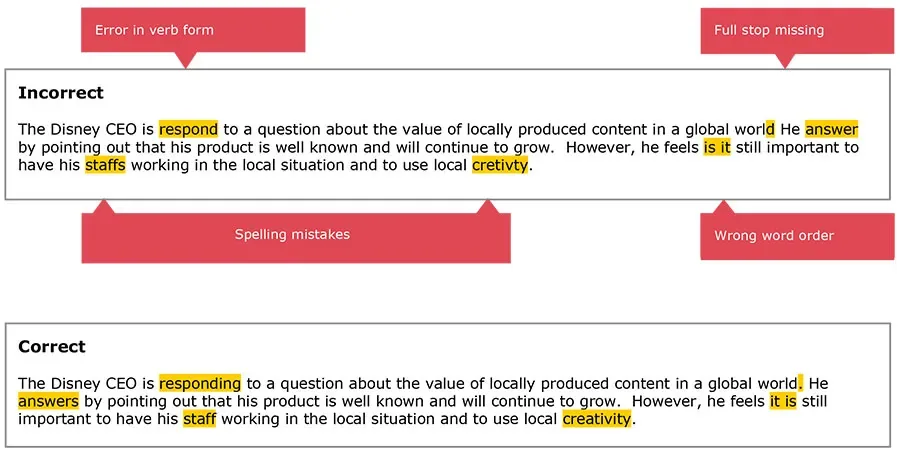
    Remember to check grammar, spelling and punctuation

    In your 50–70 word summary, you will be scored on the enabling skills of grammar, spelling and vocabulary. So leave yourself one or two minutes after you have written your summary to check your sentences for things like subject/verb agreement, tenses and word order.

    Use grammatical structures that you can use confidently, and words that you are sure you have spelled correctly. Finally, check your punctuation: check full stops and commas, and make sure you have begun each sentence with a capital letter.

    Incorrect vs correct example highlighting verb form, spelling, word order and punctuation errors
    How this question is scored

    Your Summarize Spoken Text score combines five traits: Content, Form, Grammar, Vocabulary and Spelling. Open the cards below to see what raises and lowers your score, with the full official band descriptors.

    SST is the only Listening task with a Content trait (max 4) and the only one human-reviewed. It also scores Form, Grammar, Vocabulary and Spelling — so a good SST feeds five different sub-scores.

    What raises your score
    • Take notes by topic + 3 key points + conclusion.
    • Open with: ‘The lecturer discusses … and explains that …’
    • Use one connective per sentence (Furthermore, Additionally, In conclusion).
    What lowers it
    • Copying long phrases from the audio.
    • Going over 70 words (Form drops).
    Click a band to exploreMax 4
    4
    • Comprehensive summary; effective paraphrasing; main ideas synthesized concisely.
    • ◾Partial credit applies to Content, Grammar, Vocabulary and Spelling. Form is all-or-nothing — outside 50–70 words, or written as bullet points / all capitals, scores 0 on Form (and 0 on Content).
    • ◾This question type contributes to your Listening and Writing scores.

    Keep going with Summarize Spoken Text