Circle the topic
Circle the topic in the essay question. Then underline the part of the topic you must write about — e.g. 'taking part in sport as an adult', and 'important for health and happiness'.

Write Essay (WE) is a Writing task that tests your ability to plan, structure and write a 200–300 word argumentative essay in 20 minutes. On this page: an overview, top strategies for the 20-minute window, the exam interface, sample prompts, common mistakes, the official PETA worksheet, and a full writing simulator.
Length of prompt:
2–3 sentences
Plan, write & revise time:
20 minutes
Word range:
200–300 words
Number of these tasks:
1–2
Write Essay tests your ability to write a clear, argumentative essay on a familiar topic — developing a position, supporting it with reasons or examples, and controlling standard written English.
Task
Write Essay
Writing
Overall
Your writing → analysed by AI + human expert → contributes 56% to Writing and 12% to Overall.
Official PTE School walkthrough — how to answer Write Essay.
The screen below is annotated with green markers (1–5). Each marker is explained on hover — they cover the timer, instructions, the essay prompt, the response box with Cut/Copy/Paste + word counter, and the Next button.
You will have 20 minutes to plan, write and revise an essay about the topic below. Your response will be judged on how well you develop a position, organize your ideas, present supporting details, and control the elements of standard written English. You should write 200–300 words.2Read the instructions carefully — you must write 200–300 words in formal academic English.
Tobacco, mainly in the form of cigarettes, is one of the most widely-used drugs in the world. Over a billion adults legally smoke tobacco every day. The long term health costs are high - for smokers themselves, and for the wider community in terms of health care costs and lost productivity.
Do governments have a legitimate role to legislate to protect citizens from the harmful effects of their own decisions to smoke, or are such decisions up to the individual?
Hover the green markers to see what each part of the screen does.
Skill assessed
Writing
Score weight
up to31points
The AI scorer checks
Criterion
Writing under timed conditions.
Criterion
Writing within a fixed word range (200–300 words).
Criterion
Developing a clear position with supporting reasons and examples.
Criterion
Organising ideas into introduction, body paragraphs and conclusion.
Vocabulary
Using a range of academic vocabulary and accurate grammar.
Criterion
Controlling spelling, punctuation and capitalisation.
Approach essay writing by following these three steps. Internalise them so they happen automatically on test day.
Circle the topic in the essay question. Then underline the part of the topic you must write about — e.g. 'taking part in sport as an adult', and 'important for health and happiness'.
Find the instruction that tells you exactly what to do — e.g. agree or disagree with a statement; argue for or against an opinion; discuss advantages and disadvantages; problems or solutions. 'To what extent do you agree?' = give reasons and/or examples to support your ideas.
Plan a logical structure: short introduction (general statement + your position) → 2–3 body paragraphs (one main argument each, with support) → short conclusion that restates your main argument.
Spend some time brainstorming ideas for essay topics. You usually have to give reasons for and against an idea — practise thinking of arguments (reasons in favour of an opinion), counter-arguments (reasons against that opinion) and rebuttals (reasons why even the counter-arguments could be wrong).
Try writing main paragraphs first, then the introduction and conclusion last. Many people find this helpful. Practise different approaches and see which ones work for you.
Practise checking and editing your writing, especially for grammar, vocabulary and punctuation mistakes. Get used to identifying your own weak areas and common mistakes — there's no spell-check function in the test.
Time yourself writing and completing essay tasks in 20 minutes with a maximum of 300 words. Work out how much time you should allocate to planning, writing and checking. Also practise typing an essay quickly.
You write a clear introduction, 2–3 body paragraphs and a conclusion.
You don't write one long block of text without paragraphs.
You stay on the topic from start to finish.
You don't drift onto a related but different topic (e.g. schoolchildren when the question is about adults).
You support every main point with a reason or example.
You don't make claims with no support.
You write 200–300 words.
You don't write fewer than 200 or more than 300 — both lower your score.
You use linking words and a range of sentence structures.
You don't use bullet points or memorised templates.
You spend the last 2–3 minutes proofreading.
You don't keep writing right up to 00:00 with no time to check.
Watch the most frequent mistakes test takers make in Write Essay — and how to avoid each one.
Read the brief
Identify the topic AND the instruction (agree/disagree, discuss, argue, problems/solutions) before you plan.
Use your 20 minutes
Plan ~3 min · write ~13 min · revise ~3 min. Don't keep writing until 00:00.
Stay inside 200–300 words
Word range is strict. One sentence per idea, paragraphs separated, only one topic.
Before you write anything, note key words in the prompt. Find out the topic, what key points you should focus on to answer the question, and any points of view to present and discuss: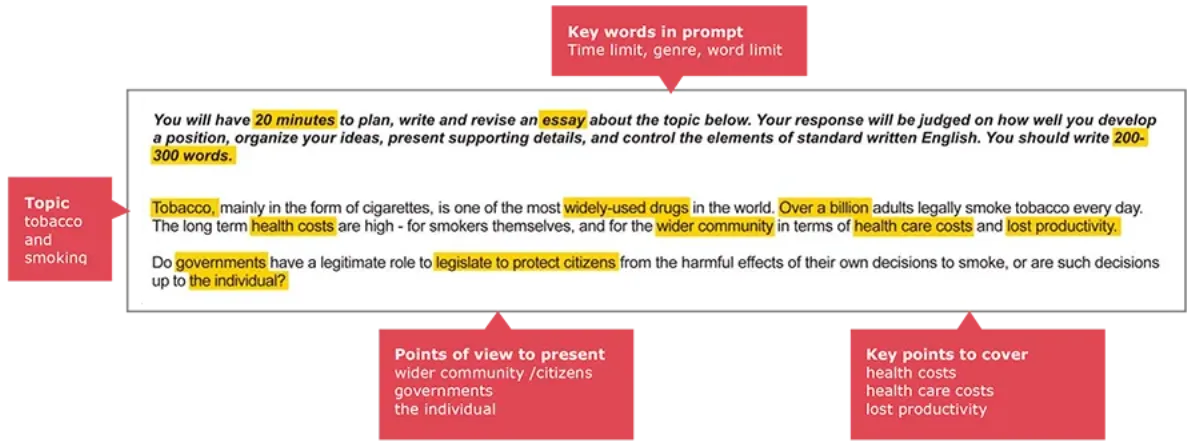
Essay prompts can be written in a number of ways. For example, you may need to discuss whether you agree or disagree with a statement:
You may have to consider how different groups of people might feel about a particular situation:
Your Write Essay score combines seven traits: Content, Form, Development/Structure/Coherence, Grammar, Linguistic Range, Vocabulary and Spelling. Open the cards below to see what raises and lowers your score, with the full official band descriptors.
Content is the heaviest single trait in Write Essay (max 6) and the only Content-bearing trait in Summarize Written Text (max 3). Examiners check that you covered the question, supported your view, and used your own words.
Coach tip · Plan 2 minutes before you type — a structured essay always beats a long unstructured one.
Practise on the same prompt used in the worked example. Real exam timing — 20 minutes to plan, write and revise (200–300 words). Compare your answer with the model below.
You will have 20 minutes to plan, write and revise an essay about the topic below. Your response will be judged on how well you develop a position, organize your ideas, present supporting details, and control the elements of standard written English. You should write 200–300 words.
Tobacco, mainly in the form of cigarettes, is one of the most widely-used drugs in the world. Over a billion adults legally smoke tobacco every day. The long term health costs are high - for smokers themselves, and for the wider community in terms of health care costs and lost productivity.
Do governments have a legitimate role to legislate to protect citizens from the harmful effects of their own decisions to smoke, or are such decisions up to the individual?
Tobacco use remains one of the most pressing public-health issues of our time. Although adults have the right to make their own lifestyle choices, governments also have a clear responsibility to protect their citizens, and in my view this responsibility justifies sensible legislation around smoking.
The main argument for government action is the cost smoking imposes on the wider community. Treating smoking-related illnesses places enormous strain on public health budgets, and lost productivity through illness and premature death affects every taxpayer. Because these costs are shared, the choice to smoke is never purely personal. Restricting advertising, increasing taxes on tobacco and banning smoking in public spaces have all been shown to reduce uptake, particularly among young people.
It is true that adults should generally be free to make their own decisions, even unhealthy ones. However, nicotine is highly addictive, and most smokers begin in their teenage years before they can give true informed consent. Legislation that delays first use therefore protects future adults from a decision they may later regret.
In conclusion, while individual freedom matters, governments are right to legislate against the most harmful aspects of tobacco use. The combined health, economic and social costs are simply too great to leave entirely to individual choice.
Send your final essay on WhatsApp and our trainers will give you personalised feedback on Content, Form, Development & Structure, Grammar, Linguistic Range, Vocabulary and Spelling.
💬 Get evaluated on WhatsApp
Work through the short exercises below — they target the essential essay-writing sub-skills: knowing the rules of the task, choosing the right paragraph topics, generating ideas with prompts like because / therefore / for example, using verbs of result (enable, prevent), considering opposing viewpoints with concession sentences, and finally writing your own response. Type your answers, then click Answer to check.
Adapted from The Official Guide to PTE Academic, 3rd edition · Pearson Education. Click each step to expand, answer, then reveal the model answer.
Step 1 of 11
Answer Yes or No for each question about the Write Essay task. Type Y or N for each.
1. Twenty minutes isn't very long, so is it a good idea to start writing the introduction immediately?
2. Will I get a lower score if I write fewer than 200 words?
3. Will the opinions I give affect my score?
4. Must I write in paragraphs?
5. Can I use bullet points?
6. Is it important to use punctuation correctly?
7. Can I use US spellings?
8. Someone told me I should memorise lots of essays so that I have one ready for whatever topic I am given. Is this a good idea?
Step 2 of 11
Match each Yes/No question from Exercise 1 with the reason that explains it.
Options
Step 3 of 11
Read the essay question:<br/><em>'Taking part in sport as an adult is important for health and happiness.' To what extent do you agree with this statement? Provide reasons and/or examples to support your ideas.</em><br/><br/>An essay of this length needs only two or three main paragraphs plus an introduction and a conclusion. Tick the BEST option for the two body paragraphs.
Tick 1 · Selected 0/1
Step 4 of 11
Complete each sentence to generate one idea you could use in the essay.
1. Taking part in sport is important for health because …
2. Joining a sports club is a good way of meeting regularly with friends and therefore …
3. People often find taking part in sport more motivating than exercising alone. This is because … For example …
Step 5 of 11
Phrases with verbs that refer to results — like <em>enable</em> and <em>prevent</em> — can help you think of ideas. Complete each sentence with two ideas.
1. Taking part in sport enables you to …
2. Taking part in sport prevents you from …
Step 6 of 11
Even if the statement in the essay title is generally true, it can be useful to consider opposing viewpoints. Complete the notes about why sport could be 'bad' or cause negative emotions.
1. Bad for health — Can cause injuries (what type? from what sport? specific person?) …
2. Possible negative emotions — Anger (why?) …
3. Possible negative emotions — Stress (why?) …
Step 7 of 11
If you don't want to write a whole paragraph on the opposing view, use a <strong>concession</strong> — admit it may have some truth, then contrast it with your main opinion. Read the examples and answer.<br/><br/><em>1. Although competitive sports can sometimes cause stress or anxiety, most people enjoy the challenge.</em><br/><em>2. It is true that focusing on the competitive nature of some sports can make some people angry instead of happy, but most people do not react like this.</em>
1. 1a — What linking word is used to introduce the concession?
2. 1b — What punctuation mark separates the concession from the main opinion?
3. 2a — What phrase is used to introduce the concession?
4. 2b — What linking word is used to introduce the main opinion?
Step 8 of 11
Use your ideas from the previous exercise (injuries, anger, stress) to write two concession sentences. Use <em>Although</em> for one and <em>It is true that … but</em> for the other.
1. Concession sentence 1 — using 'Although …'
2. Concession sentence 2 — using 'It is true that … but …'
Step 9 of 11
Your conclusion needs to restate your opinion and the most important reason. You can also include a concession sentence. Put the words in the correct order to make a two-sentence conclusion.
1. 1 — taking part in sport / to maintain health and happiness / all in all / helps most adults
2. 2 — but it is certainly one of the most obvious / the only means of achieving this, / ways to promote physical and mental health / it is true that sport is not
Step 10 of 11
Read three example introductions for the sport essay. Tick the one you think is best.
Tick 1 · Selected 0/1
Step 11 of 11
Now put it all together. Write your OWN response (200–300 words) to the essay question:<br/><em>'Taking part in sport as an adult is important for health and happiness.' To what extent do you agree with this statement? Provide reasons and/or examples to support your ideas.</em><br/><br/>Then read it through twice — first sentence by sentence to check completeness, then for typos, spelling and small grammar errors.