
PTE Made Easy·WFDlistening Total time for all listening tasks: 31–39 minutes
    Made Easy

    Write from Dictation

    Write from Dictation (WFD) is the final task of the Listening section and the highest-yield item type in the entire test — it contributes heavily to both your Listening and your Writing scores. You'll hear a short sentence once and type it word-for-word into the response box. On this page: an overview, the exam interface, top strategies, common mistakes, points to remember and a full simulator with practice items.

    Chapter

    Overview

    • Length of audio:

      3–5 seconds

    • Number of these tasks in each test:

      3–4

    • Type of recording:

      audio only — short sentence

    • Time to answer:

      type and click Next when ready

    • Time limit for all listening tasks:

      31–39 minutes

    In Write from Dictation you hear a short sentence once. Type the sentence into the response box exactly as you hear it. Every correctly spelled word scores one point — partial credit applies, so even a partial answer scores.

    • The audio plays automatically — there is no replay.
    • You can take notes on the erasable noteboard while you listen.
    • Type the words you remember in the correct order — use English grammar to place words you're unsure of.
    • This task contributes to BOTH your Listening and your Writing scores.
    Scored by AI

    How Write from Dictation contributes to your score

    AI
    scoring
    0%

    Listening

    0%

    Writing

    0%

    Overall

    Your voice → analysed by AI → contributes 13% to Listening, 23% to Writing and 5% to Overall.

    Watch — How To Answer Write from Dictation

    Official PTE School walkthrough — how to answer Write from Dictation.

    How the test screen works

    The screen below is annotated with green markers (1–5). Press Start: a 3-second countdown plays (3 · 2 · 1), then the audio plays automatically. You CANNOT pause or replay it. Type the sentence into the response box. The Next button is disabled while the audio is still playing — you must wait until it finishes before you can move on.

    SimulatorReady
    PPTE Academic — Listening · Write from Dictation
    Time Remaining 01:00 1 of 4
    1Total task time. Counts down once you press Start.

    You will hear a sentence. Type the sentence in the box below exactly as you hear it. Write as much of the sentence as you can. You will hear the sentence only once.2Read the instructions — type the sentence you hear word-for-word.

    Audio Player

    Press Start to begin

    3Audio player. Plays automatically after a 3-second countdown. You only hear it once — no replay.
    Type the sentence you hear:0 Words
    4Type the sentence here. Use your knowledge of grammar to place words you remember in the right order.
    5Click 'Next' once you're done. Disabled while the audio is still playing.

    Hover the green markers to see what each part of the screen does.

    Write from Dictation — Exam InterfaceAnnotated walkthrough of the actual Pearson screen. 3-second countdown → sentence plays once → type your response → press Next.
    WFD 1

    What this task tests

    Skills assessed · 2 strands

    Listening + Writing

    Combined score weight

    up to3613 + 23 points

    This task feeds two separate score strands. The AI evaluates different things for each — see the breakdown below.

    Strand

    Listening

    up to13points

    The AI scorer checks

    Criterion

    Holding a 3–5 second sentence in working memory.

    Criterion

    Distinguishing function words (a, the, of, for) that are easy to drop.

    Criterion

    Recognising less-common content words quickly.

    Strand

    Writing

    up to23points

    The AI scorer checks

    Criterion

    Spelling content words correctly (governance, corporation, severely…).

    Criterion

    Typing accurately under time pressure without copy/paste.

    Grammar

    Using grammar to keep word order correct even if a word is missed.

    Chapter

    Top Strategies for Success in Write from Dictation

    Ensure that you are confident about spelling

    Spelling is everything in Write from Dictation — every correctly spelled word earns a point, every misspelled word scores zero. Build the four habits below before you sit the exam.

    Learn the regular spelling conventions

    Review the regular spelling conventions in English. Make a list of words you tend to find difficult to spell, especially words with ie or ei (e.g. piece, receipt), or double-consonant spellings like mm, pp and ss (e.g. communication, disappointed, business). Try to learn words with similar spellings together.
    Watch out for similar-sounding words

    Be aware that a lot of words sound similar in English but have very different spellings and sometimes different meanings — e.g. accept / except, principal / principle, past / passed, piece / peace.

    Know the word forms

    Many words have different forms for different parts of speech, e.g. severity (noun), severe (adjective), severely (adverb). In the test, you may mishear part of a word, so being able to work out which form of the word is correct and how to spell it can help you.

    Practise spelling unfamiliar words

    Being able to guess the spelling of unfamiliar words is important. Try writing down a small number of unfamiliar words you hear in online videos, academic podcasts and lectures. Choose important words that are related to the main theme of the text. Then check the spelling of these words (e.g. with a transcript of the recordings, if available, or with a dictionary).

    Practice tips

    You won't be able to remember the whole sentence, so you will need to take notes of the main words while you listen. Practise listening to one-sentence extracts and decide whether you prefer handwriting or typing what you hear. Once you have made the decision, practise your chosen method and stick with it.

    Native speakers of English don't pronounce every single word clearly. However, they do stress important words (usually nouns, verbs and adjectives) more clearly. Practise identifying stressed words in online lectures or podcasts. Pay attention to those words which are pronounced more clearly and see if you can build up a general picture of what the person is talking about.

    Practise building up a sentence from stressed words. Listen to a short sentence from an online lecture or podcast. Play it two or three times. As you do so, write down the stressed words that you hear. Don't try to write down every single word. Then, without listening again, use the stressed words to create the full sentence. Use your knowledge of grammar and smaller words like a, the, of (which are not usually pronounced clearly) to construct the sentence. Then listen again to check your sentence.

    Find transcripts of lectures or podcasts to work out the errors in your response. What kind of errors do you tend to make? Are they grammar, punctuation or vocabulary based? Reflecting on what you write as you practise will help you pinpoint where you need to work on improving your skills.

    Quick tips — Do this, not that

    • Tip 01

      You listen to the whole sentence before typing.

      You don't start typing while the audio is still playing — you'll miss the end.

    • Tip 02

      You write every word you remember, even if unsure of order.

      You don't leave words out because you can't place them — guess the slot using grammar.

    • Tip 03

      You spell each word carefully.

      You don't rush past spelling — wrong spelling scores 0 for that word.

    • Tip 04

      You include all small function words (a, the, of, for).

      You don't drop tiny words — each one is worth a point.

    • Tip 05

      You click Next promptly after a quick proofread.

      You don't waste time — listening items share a 31–39 minute pool.

    Chapter

    Practice now with your trainer

    Practice — second item

    Practise here with the same exam timing. Press Start: 3-second countdown → sentence plays once → type the sentence → press Next.

    SimulatorReady
    PPTE Academic — Listening · Write from Dictation
    Time Remaining 01:00 2 of 4

    You will hear a sentence. Type the sentence in the box below exactly as you hear it. Write as much of the sentence as you can. You will hear the sentence only once.

    Audio Player

    Press Start to begin

    Type the sentence you hear:0 Words
    Practice question — Write from DictationSame Pearson-style screen as the real test. Listen, type, review.
    WFD 2

    Reflection checklist

    Private to you — tick each item you actually did. Saved on this device only.

    0/7

    Want a trainer to mark your WFD answers?

    Send your typed sentence on WhatsApp and our trainers will tell you exactly which words you missed and which spelling traps to drill.

    💬 Get evaluated on WhatsApp

    Common Mistakes in Write from Dictation

    Watch the most frequent mistakes test takers make in Write from Dictation — and how to avoid each one.

    Points to remember

    Listening tasks
    • 1

      Type as many correct words as you can remember in the right order

      You will score points for every correct word that you write in the response box. If you can remember a word but you are not sure where it goes in the sentence, use your knowledge of English grammar to help you decide. Spelling counts — every word must be spelled correctly to score that point.

    • 2

      Manage your time across the whole listening section

      Listening items (apart from Summarize Spoken Text) are not timed individually. You will have between 31 to 39 minutes for all the listening items. Make sure you practise managing your time effectively across all the tasks.

    Chapter

    Most Repeated Write from Dictation Questions in 2026

    Most repeated WFD questions in 2026

    Practise the highest-frequency Write from Dictation sentences reported from recent exams. Press play, listen once, then type the sentence. Reveal the transcript below to check your answer.

    Most Repeated Write from Dictation Questions

    1. 1
      Show transcript

      Listen to the sentence and type it exactly as you hear it.

      📄 TranscriptShow

      Native speakers are exempt from the language tests in their own language.

    2. 2
      Show transcript

      Listen to the sentence and type it exactly as you hear it.

      📄 TranscriptShow

      Psychologists say that what we have experienced has more impact on us than what we are told.

    3. 3
      Show transcript

      Listen to the sentence and type it exactly as you hear it.

      📄 TranscriptShow

      The toughest part for education is funding.

    4. 4
      Show transcript

      Listen to the sentence and type it exactly as you hear it.

      📄 TranscriptShow

      Undergraduates may show more interest in special stages within specific programs.

    5. 5
      Show transcript

      Listen to the sentence and type it exactly as you hear it.

      📄 TranscriptShow

      The placement test for mathematics and statistics will be offered every semester.

    6. 6
      Show transcript

      Listen to the sentence and type it exactly as you hear it.

      📄 TranscriptShow

      Assignments should be submitted to the department office before the deadline.

    7. 7
      Show transcript

      Listen to the sentence and type it exactly as you hear it.

      📄 TranscriptShow

      This article refers to a number of interesting experiments.

    8. 8
      Show transcript

      Listen to the sentence and type it exactly as you hear it.

      📄 TranscriptShow

      The library is located on the other side of the campus behind the student centre.

    9. 9
      Show transcript

      Listen to the sentence and type it exactly as you hear it.

      📄 TranscriptShow

      More muscles are used in swimming than in other sports.

    10. 10
      Show transcript

      Listen to the sentence and type it exactly as you hear it.

      📄 TranscriptShow

      Mutually exclusive events can be described as either complementary or opposite.

    Quick Tips for a Better Score

    Type as many correct words as you can remember into the response box in the correct order

    You will score points for every correct word that you write in the response box. If you can remember a word but you are not sure where it goes in the sentence, use your knowledge of English grammar to help you decide.

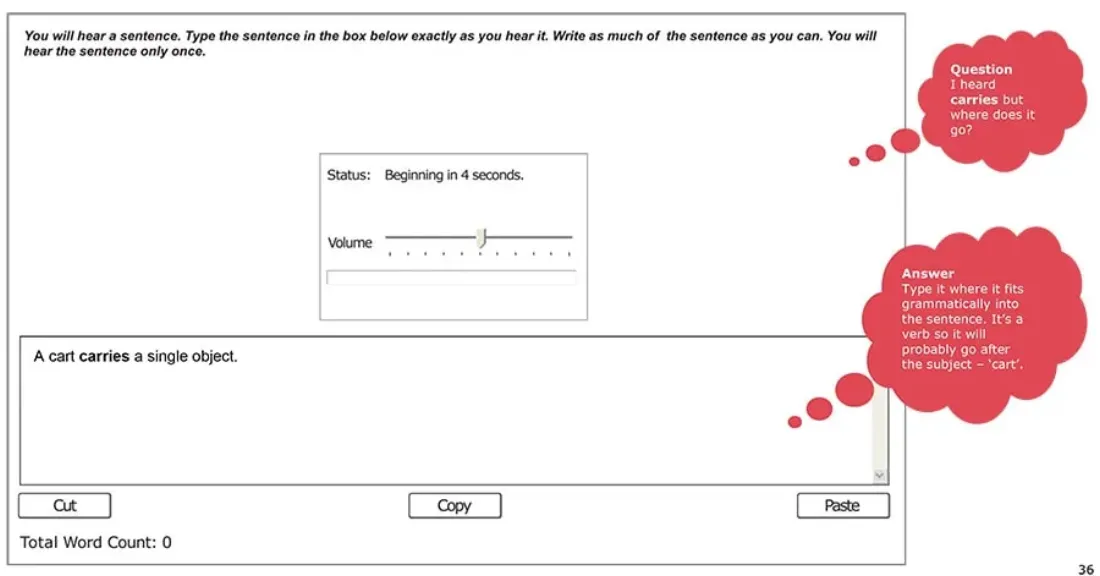
    Example: if you heard the word carries but aren't sure where it fits, type it where it works grammatically. It's a verb, so it will probably go after the subject — e.g. 'A cart carries a single object.'

    Don't leave a word out just because you can't place it — guess the slot using grammar. Every correctly spelled word in roughly the right position earns a point.

    Pearson Write from Dictation screen showing the response box with the example sentence 'A cart carries a single object.'
    How this question is scored

    Partial credit — no negative marking.

    +1 point for each word from the original sentence that is spelled correctly and in the right order.
    0 points for any word that is misspelled, missing, or in the wrong place.
    Minimum score is 0 — extra or wrong words do NOT subtract points, but they don't add any either.

    This question type contributes to BOTH your Listening AND Writing scores. Because it's the highest-yield item in the entire test, every correctly typed word matters.

    Listening Fill in the Blanks and Write from Dictation give you a point for each word typed and spelled correctly. WFD is the highest-yield Listening task because every word you nail counts.

    What raises your score
    • Type every word you’re sure of, then fill the gaps with grammatical guesses.
    • Use shorthand notes during the audio (first letter + length).
    • Practise dictation with British, American AND Australian voices.
    What lowers it
    • Spelling errors on common words (their/there, its/it’s).
    • Adding a word that wasn’t in the audio.
    Click a band to exploreMax 1
    1
    • Each correct word spelled correctly.

    Coach tip · Every word counts — never leave a blank empty. There's no negative marking, so a grammatical guess is always better than nothing.

    • ◾+1 for each correctly spelled word in the right order.
    • ◾0 for misspelled, missing, or out-of-order words.
    • ◾No negative marking — extra words don't reduce your score.
    • ◾Contributes to BOTH Listening (up to 13 points) and Writing (up to 23 points).
    • ◾Spelling matters: a correctly remembered word that's misspelled scores zero.

    Keep going with Write from Dictation